Quick Facts
Individuals served in FY22: 7,515
- Through new construction – 295
- Through incremental building – 3,030
- Through market development – 4,190
Volunteers engaged in FY22: 1
Other facts:
- Population: over 22.1 million
- Life expectancy: 76 years
- Unemployment rate: 6.7%
- Population living below poverty line: 1%
Source: World Factbook
Habitat for Humanity in Sri Lanka
Habitat for Humanity Sri Lanka seeks to provide decent and affordable housing to marginalized and vulnerable communities across the country. Established in 1994, Habitat Sri Lanka has enabled more than 25,400 families to build strength, stability and self-reliance through shelter. Habitat also implements water, sanitation and hygiene projects. To rebuild lives and increase resilience, Habitat Sri Lanka works with disaster-affected families to build homes and conducts training in disaster risk reduction.
The housing need in Sri Lanka
Despite great advances as a result of Sri Lanka’s housing programs, the country’s need for secure and affordable homes is made more pressing by poverty, under- development and disasters such as floods and landslides. More than a decade after the end of the civil war, many internally displaced families are still living in inadequate shelter in the north and east of the country. The last housing needs survey by the government was in 2016, which showed 800,000 families out of 6 million families in the country did not have a home of their own. In the tea plantation districts, workers live in “line rooms” without proper water and sanitation facilities. Many of them still lack adequate homes despite the launch of a major government housing initiative with funding support from the Government of India in the central, southern and western provinces.
How Habitat addresses the need in Sri Lanka
For nearly 25 years, Habitat Sri Lanka has partnered with supporters and volunteers to build decent and affordable homes for families in need of adequate housing. Following the 2004 Indian Ocean Tsunami nearly 3,000 families were supported to rebuild their homes through the reconstruction housing project led by Habitat Sri Lanka. In May 2013, a 4,000-home housing project funded by the Indian government for internally displaced people in the Eastern Province was launched. In February 2017, a 14-million-euro (more than US$14.8 million) project funded by the European Union broke ground in the Kilinochchi, Mullaitivu and Batticaloa districts. The multi-faceted housing project will support 2,455 war-affected families in northern and eastern Sri Lanka and feature the use of locally made construction materials. In 2018, Habitat Sri Lanka constructed nearly 100 homes for rural plantation workers with funding from the Indian government, and 37 homes were constructed for flood-affected families in Kalutara.
Safe, affordable housing
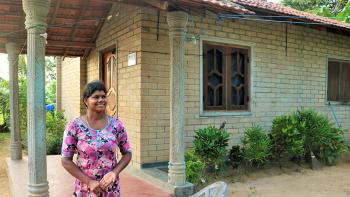
Habitat Sri Lanka partners with families to build 51-square-meter core homes that they can expand in future when funds are available. The 100-home GRACE project exemplifies both new construction and building in stages. Habitat’s preferred approach is homeowner-driven construction where families take ownership of the construction process by managing financial resources and procuring the services of construction workers and supplies of building materials. The families select the housing design, choose the building materials and suppliers while Habitat Sri Lanka provides technical assistance and construction expertise. Families and local construction workers are also trained in the use of eco-friendly, locally available construction materials such as compressed stabilized earth blocks and other appropriate construction technologies.
Water and sanitation
Chronic kidney disease is a serious health problem, particularly in rural Sri Lanka. Habitat is committed to providing families with access to safe drinking water through the construction of toilets, installation of water tanks and training in good hygienic practices. In 2021, Habitat partnered with the American Chamber of Commerce, or AmCham, in Sri Lanka to provide water, sanitation and hygiene facilities to government schools through the Helping Hands project. The three-year partnership aims to improve school children’s access to clean water and improved toilets and raise their awareness of handwashing, hygienic practices. Menstrual hygiene training also helps to promote girls’ health, dignity and well-being as well as their school attendance. In the first year of the project, more than 2,500 students in three government schools benefitted with the support of AmCham’s Sri Lankan corporate members..