100,000 Concrete Floors
100,000 Concrete Floors
to Play On and Study
The 100,000 Floors to Play On initiative, introduced in 2022, seeks to replace 100,000 dirt floors or floors in poor condition with concrete floors in vulnerable homes across the region by 2028. One of its main impacts is related to the effect of flooring on the time children devote to studying and the time they spend at home.
With the goal of gathering evidence to demonstrate the benefits of concrete floors on people’s quality of life, we produced the report A Floor Is Resilience. The Impact of Concrete Floors on the Lives of Families in Latin America and the Caribbean 2025. This study was based on the findings of three impact evaluations carried out in our region: one quantitative study in the Dominican Republic and two qualitative studies in Nicaragua and Guatemala, published in 2024.
The methodology developed sought to demonstrate the impact of building concrete floors in the areas of economic development, health and well-being, school absenteeism, and hours of play inside the home. This is essential for highlighting the importance of continuing to develop this initiative in other geographic areas and countries in the region, and for making donors and partners aware of the potential impacts generated by replacing dirt floors with concrete ones.
The measurements carried out allowed us to recognize that the families who received a concrete floor improved their quality of life and their enjoyment of their home:
- They increased their perception of the quality of the home’s infrastructure by 4%, and satisfaction with the floor and the home by 239% and 25%, respectively.
- They achieved 79% savings in medical expenses.
- They reached 20% greater financial stability.
- Their investment in the home increased by 12%.
Other studies, such as the one by the University of Berkeley and the Inter-American Development Bank (2007), also highlight the impact of concrete floors on children’s cognitive development and health. This improvement reduces the risk of contracting illnesses such as anemia in 8 out of 10 children, cuts the chances of diarrhea in half, and prevents 78% of parasitic infections. In the case of adults, having a concrete floor considerably reduces symptoms of depression and stress.
With regard to education, our study showed that having a concrete floor reduces school dropout, as children miss 15% fewer classes. This is essential to maintain their learning level, reduce inequalities, and create opportunities for their future; attending school consistently helps improve social and work-related skills and decreases the risk of becoming involved in disciplinary problems.
79% savings in medical expenses
20% greater financial stability
12% increase in home investment
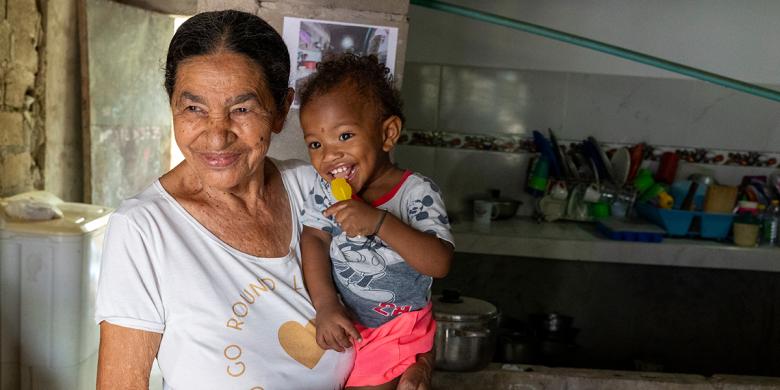
PHOTO. CARTAGENA, COLOMBIA. Isabel María arrived in the Olaya Herrera neighborhood in Cartagena 33 years ago after being displaced by violence. Through her own effort she acquired her home and, after separating, took on the upbringing of her two children and two grandchildren. Today she feels at peace seeing her grandson crawl safely on the new concrete floor installed thanks to 100 Thousand Floors to Play. © Habitat for Humanity International / David Estrada
15% increase in school attendance
80% increase in playtime at home
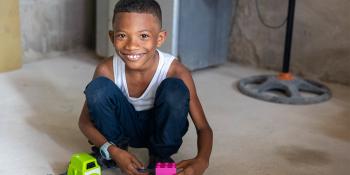
The evaluation results showed that having a concrete floor increases playtime at home by two hours, that is, an 80% increase. This is a significant figure, since play fosters key skills in cognitive, emotional, social, and physical areas; strengthens family bonds, particularly in vulnerable contexts; and turns the home into a setting of enjoyment and happiness where people want to spend more time.
At the family level, a concrete floor contributes to greater resilience because it allows people to better withstand tensions and contextual shocks such as climate events, economic crises, and disease outbreaks; it provides greater financial stability and lower health-related expenses, while also encouraging greater investment in housing and increasing satisfaction with it.
These results allow us to state that concrete floors do make a difference in families’ quality of life, especially for children, and that this deserves to be replicated in other territories and countries.
Together, we will continue building more concrete floors for a safe and happy childhood.
Keeping notebooks and school supplies clean and away from the dust and dirt of the floor, as well as being able to invite other children to study at home without embarrassment, contributes to better academic performance and increases interest in studying.
As of December 2025, nearly 30,053 floors have been built in Brazil, Colombia, Costa Rica, Ecuador, El Salvador, Guatemala, Honduras, Mexico, Nicaragua, Peru, and the Dominican Republic.