Financial stability
starts with a home
Financial stability starts with a home
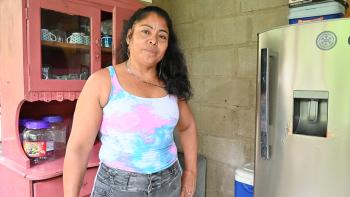
Have you ever tried an empanada, tortilla or tamal? Those traditional dishes are a key aspect of Latin American culture. The food represents not only customs but also an income for families in the region. In Honduras, Concepción prepares tortillas to sustain her family, but the dirt floor was an issue for her business. In the Dominican Republic, another source of tradition allows women to earn a living: Yohania makes braids in her house, but the dirt floor was a deterrent for clients, who complained about getting dirty when visiting her.
In Latin America & the Caribbean, housing and income are deeply intertwined. Several studies show the relevance of the economic function of housing. Families use their houses for business, commercial ventures, self-employment, subcontracting, and other income-generating activities, both formal and mainly informal.
Globally, about 260 million people work from home, and 86% of them reside in developing countries. In Latin America and the Caribbean, this number is 16.6 million, accounting for 6% of the region's total employment. The economic function of housing
The context of housing as a means for living is not unknown to Habitat. We have invested not only in improving leisure spaces—like the bedrooms or the living room—but we have also worked alongside homeowners to upgrade the areas related to their work. During the past two years, we have studied whether the families who partnered with us experienced benefits in their financial situation. Our findings allow us to show a relationship between housing and economic development.
Saving in health, investing in housing
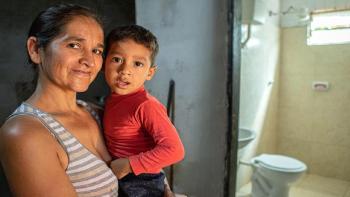
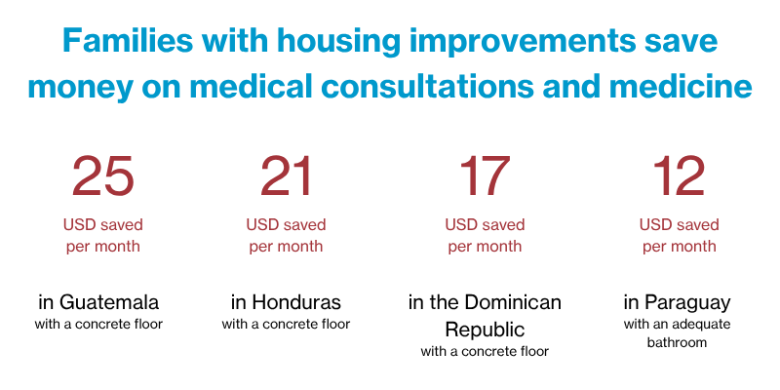
In Paraguay, families partnered with Habitat to upgrade their bathroom. This change improved their health, with a subsequent economic benefit: they had 126% lower healthcare expenses. “In the economy we improved a little more because we are not spending on medicine anymore, because we are not getting sick due to the lack of a secure and lockable space anymore”, a focus group participant shared. Families were able to save 12 dollars monthly (135,000 guaranies) in health expenses; this was 8% of their average income.
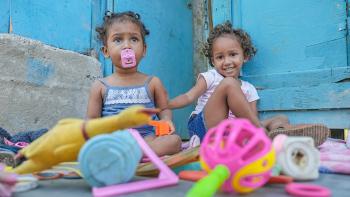
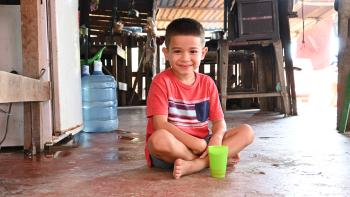
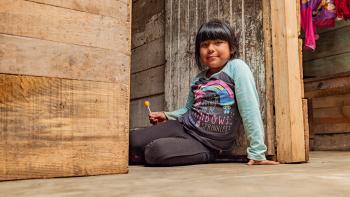
A similar result was attained after changing a dirt floor to a concrete one through the 100,000 Floors to Play On Initiative. In the Dominican Republic, families with a concrete floor saved 79% on health expenses; this was the equivalent of $17.70 per month. The ability to cover their basic needs, save, invest and access new sources of financing improved by 20%.
In Guatemala and Honduras, health expenses were reduced by 39% and 95% respectively. This represents 25 dollars (198 quetzales) and 21 dollars (579 lempiras) saved per month; 14% of their average income.
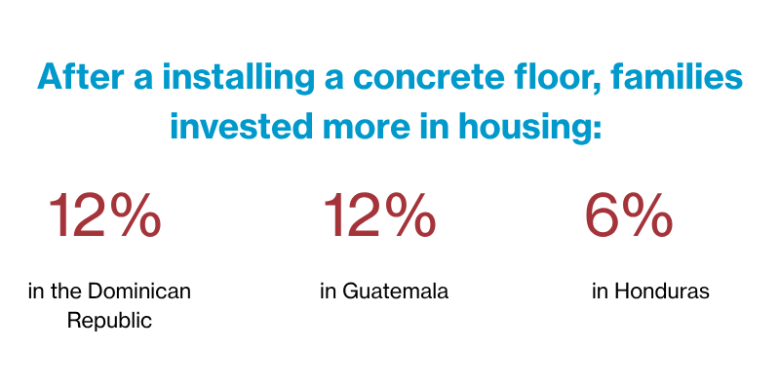
When families had more money available, they decided to invest in improving their houses. In the Dominican Republic, families reported 20% greater financial stability to meet household needs, resulting in a 12% increase in investments in the home, or $222 in three months. Honduran families invested 12% more, and Guatemalan families 6% more.
Inadequate houses are more expensive
The savings created by improving a house can be explained by the difficulties of inadequate housing. Living in a deteriorated house creates recurring expenses for households. Furniture and clothing constantly deteriorate due to excessive dirt and moisture, translating into additional expenses. For example, in Guatemala, families with dirt floors spend significant economic resources on cleaning products —such as soap, brooms, paper, and water— as well as a substantial amount of time cleaning due to the constant presence of dirt and mud inside the home.
If the house lacks appropriate water and sanitation systems, like in Paraguay, other expenses like buying and managing a water supply are required. When families do not have adequate bathrooms, they may also need to pay for using public facilities. Inadequate housing conditions also cause frequent illnesses, particularly for children, meaning extra medical costs.
Financial capital improves when families renovate their homes
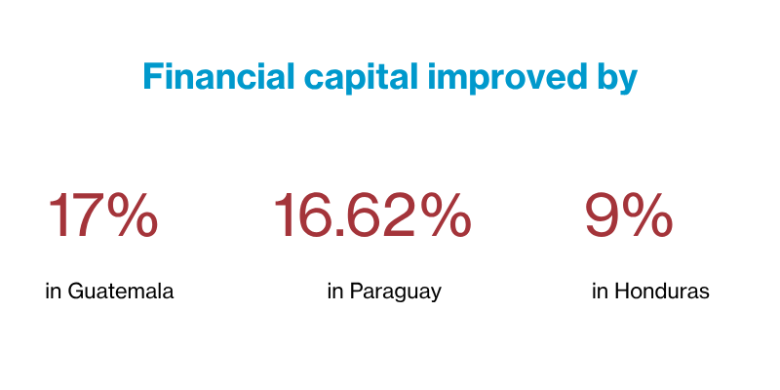
Habitat created the financial capital indicator to measure the level of financial resources a household has available to secure livelihoods. It considers the income and the access to financing available. The financial capital indicator improved in families that received a house improvement: 17% in Guatemala, 16.62% in Paraguay, and 9% in Honduras.
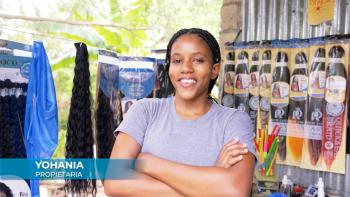
After installing a concrete floor, Yohania received compliments from her clients. In the past, her clients’ feet got dirty while their hair was being braided; now, the concrete floor reduces dust and dirt, and the clients feel happier.
Saving time and money allows people to invest in their future
When health improved, people had more opportunities to be productive. In Guatemala, absences from work and study centers were reduced by 44%; in Honduras, it was 18%. People also reported using their current saving to improve their business.
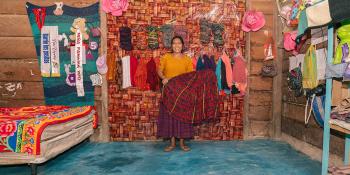
“The money we’ve saved on things like brooms and medicine, and the fact that now we spend less time cleaning, means that we can focus more on making and selling our weavings.” —María, Guatemala
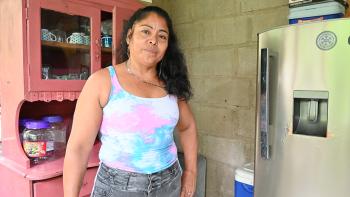
Since I got a concrete floor, the neighbors buy more tortillas from me because they notice that my house is more organized and cleaner. There is no more dust or dirt.” —Concepción, Honduras
Better housing enhances households’ economic capacity
A home is an opportunity for a family to build a better life. Throughout the region, we have supported women like Concepción and Yohania to thrive. Investing in housing is investing in small businesses that provide financial security to several families in the informal and formal sector. If you or your company want to join us in creating long-lasting impact, you can help by donating or contacting us for projects and opportunities. Together, we build a world with opportunities.