Health starts with a home
Decent housing improves people’s health
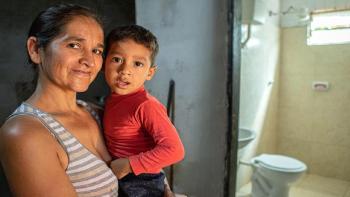
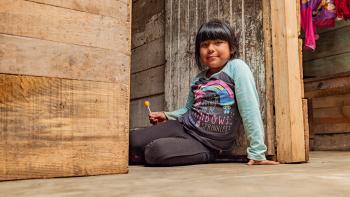
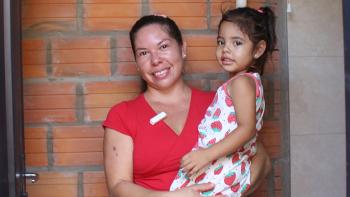
Dunia lived in a house with a dirt floor in Honduras. She mentions how cleaning was impossible and the only thing she could do was try to sweep the floor to reduce the dirt. She is not the only mother facing challenges. In the Dominican Republic, Luisa shares her testimony: “I didn’t feel good with my floor in poor condition. My little girl’s room was full of water, and if it rained everything would get dirty. She always had a cough.” In Paraguay, Gloria needed an independent bathroom for her daughter, whose treatment against breast cancer required the housing improvement.
Those three mothers share something in common besides their difficulties. They partnered with Habitat for Humanity to improve their housing conditions in different programs across the region. During the past three years, we have conducted research to understand if this decision improved something more than a physical structure. Our studies show that decent housing has a positive impact on people’s health.
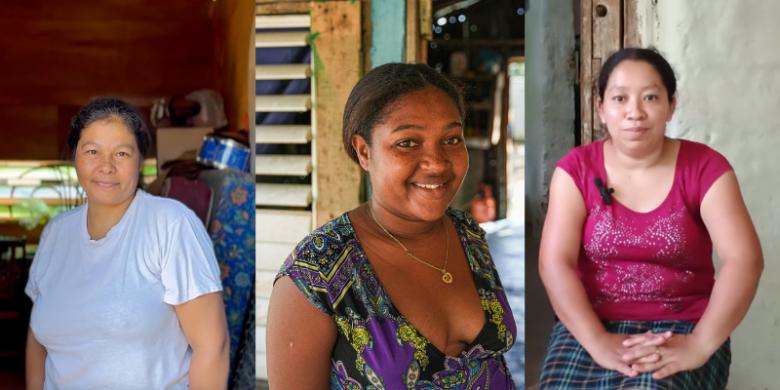
Gloria, from Paraguay; Luisa, from the Dominican Republic; and Dunia, from Honduras are mothers who worked alongside Habitat for Humanity to improve their homes.
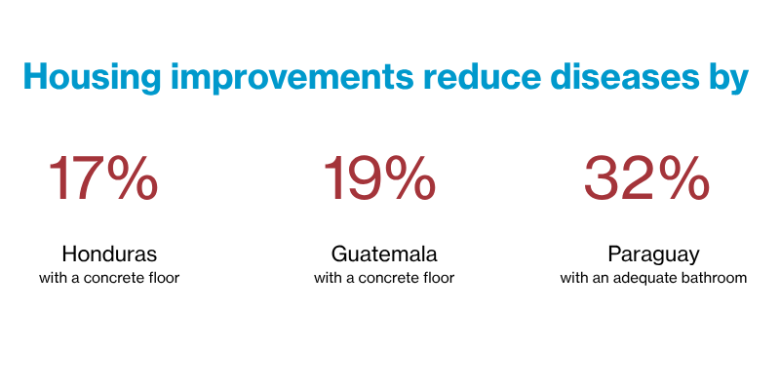
Through the 100,000 Floors to Play On Initiative, Habitat has built more than 30,000 concrete floors in Latin America & the Caribbean. This improvement has reduced respiratory, diarrheic and skin diseases by 17% in Honduras and 19% in Guatemala. Also in Guatemala, the need to visit the doctor or buy medicine has decreased by 46 %. Similarly, in Paraguay, the construction of decent bathrooms has reduced sickness by 32%, and the need for medical attention or treatment by 46%. People in this South American country have reported that their new shower facilities help them keep the space warmer, because they can close the door and windows. Additionally, they can also use hot water during winter.
Inadequate housing is linked to health issues
Silvia, from Guatemala, knows first-hand how substandard housing can affect health. “Before, the house would get so wet that my daughter was always sick. She had a lot of diarrhea and would often cough. She was sick every ten to fifteen days.” Her testimony resonates with the data gathered in our Housing and Health report. Several authors have linked inadequate housing to various health issues, including respiratoryinfections, vector-borne diseases, injuries, and gastrointestinal illnesses (Jacobs & Kelly, 2003; Torres Parra et al., 2024). In 2016, deficits in access to water, sanitation, and hygiene were directly linked to approximately 40% of all diarrhea-related deaths in the region (CAF, 2023).
Children, older adults, and women usually spend more time at home, increasing their exposure to health risks associated with housing conditions (WHO, 2022). For children, substandard housing increases the risk of injuries and respiratory problems due to toxins such as lead and mold (Reece, 2021).
Home improvements keep children healthy
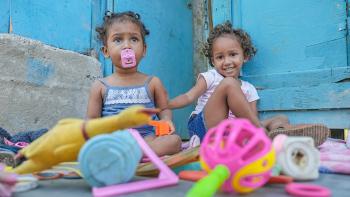
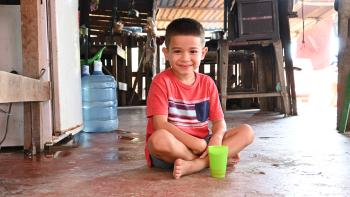
Since small children usually play on the floor, they are more exposed to contamination and humidity. They can also get hurt. Leydi, from Honduras, has noticed a change after getting a concrete floor. “It feels much better, because now the kids like to play. They are getting less sick too. Before, they had scabs, but since we got the floor, they don’t have those”.
In Housing, Health and Happiness, authors analyze the impact of replacing a dirt floor on health. The researchers found a decrease in diarrheal diseases (49%), parasitic infections (78%), and anemia (81%) for children. Günther & Fink (2011) have also mentioned that investing in water and sanitation infrastructure could prevent up to 2.2 million child deaths annually in the developing world, with an average annual cost per life saved equivalent to between 65% and 80% of these countries’ per capita GDP. In Paraguay, families that partnered with Habitat to improve their sanitation facilities experienced a 16% decrease in pediatric diarrheal diseases.
Bathrooms are also a key issue for children’s privacy and developing their sense of independence. Families in Paraguay have reported easier mornings when preparing the kids for school. During a focus group in this study, a participant shared, “Now we can take a bath under the shower, we don’t have to go out to the yard; even the children can bathe by themselves, and everything is good”.
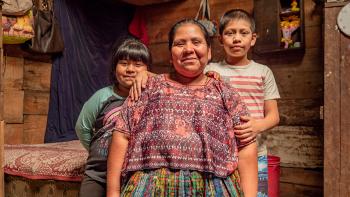
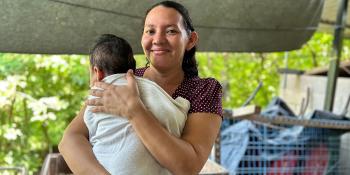
In Guatemala, a new concrete floor has helped Natalia in taking care of her grandchildren’s health.
Households reduce medical expenses
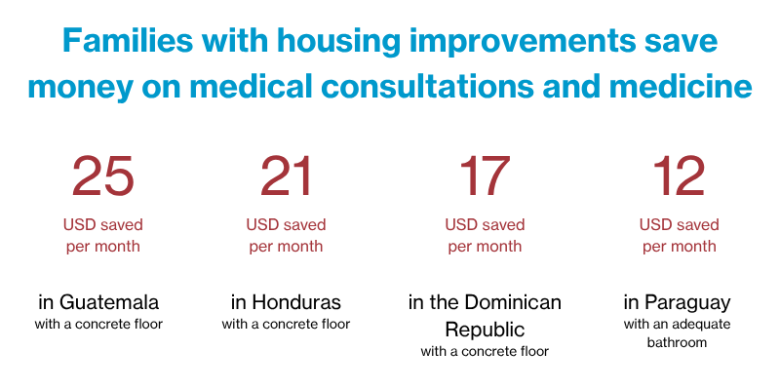
Families with adequate housing use less money on doctors and medicine. After an improvement in their bathrooms, Paraguayan families cut their need for medical attention by half, which saved them around 12 dollars monthly. Likewise, families with a new concrete floor spent 95%, 79% and 39% less on medical consultations and medicine in Honduras, the Dominican Republic and Guatemala, respectively. For Honduran families, this means saving around 21 dollars per month, about 14% of their total income. “Before we spent on medicine because the kids were usually sick, but now we don’t,” says Aidé, from Honduras.
“Before we spent more buying medicine, going to the town to look for a doctor because the children were sick more often with the flu, cough and diarrhea,” shares a participant who received a concrete floor in Guatemala.
People feel more satisfied and less stressed in a decent house
A decent place to live improves not only physical but also mental health. People in need often feel ashamed to have invitees in their house, they can also feel stressed when the space is too crowded or they lack privacy.
Previous studies have shown that mental health is affected by housing conditions. Families with a concrete floor reported a 52% decrease in depression and a 45% reduction in stress. In Habitat research, families with this improvement have reported an increased sense of well-being, which we measure by asking about the contentment with the house after the change. The satisfaction increased by 25% in the Dominican Republic, 17% in Guatemala, and 12% in Honduras.
“Now even our children are more motivated to help us with cleaning the floor because it’s easier to sweep, move things and furniture around, since the floor is smooth and doesn't kick up dust like before,” says a participant from a focus group in Petén, Guatemala, who got a new concrete floor.
In Paraguay, satisfaction with the house increased 24% after improving the bathroom facilities, but another key issue is highlighted: safety. In the focus groups for this study, families shared about fearing going outside at night to use the restroom. Sometimes, since the bathroom has no door, they have no privacy. Some of them are dependent on family members: “I always go to my son’s house, but sometimes I don’t want to intrude too much, but what can I do? I don’t have a bathroom yet,” a participant shared.
The perception of safety of the bathroom increased by 56% for the families that partnered with Habitat for this improvement. Likewise, people self-steem increased by 14 %. “Before I was feeling ashamed, now I feel better with my house, more self-confident,” a participant of the study shared. Women are especially benefited by the bathroom’s improvements, now they have more privacy and they can have more hygiene when they are having their periods.
Investing in housing means investing in people’s health
Several research studies have shown how investing in housing is more than a roof, a bathroom, or a floor. A decent house is a tool for moving families from survival mode to opportunity mode. People with better health have more chances to succeed in several aspects of their lives. If you or your company is interested in contributing to catalyze this potential, donate or contact us to work together in initiatives to build a world where everyone has a decent place to live.