The Habitat for Humanity Story
Habitat for Humanity is a global nonprofit, non-governmental organization specializing in building and improving affordable housing for low-income families.
Teaser title
The Habitat for Humanity Story
Habitat for Humanity is a global nonprofit, non-governmental organization specializing in building and improving affordable housing for low-income families.
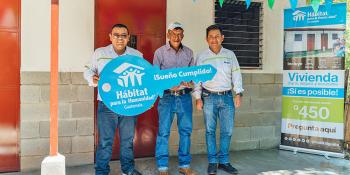
Don Juanito is a Guatemalan farmer who lived in precarious housing conditions and after meeting Habitat Guatemala again after 20 years of knowing them, he found hope in the organization. With a lot of effort, Don Juanito managed to improve his home to the point where he now has a safe and dignified hybrid house.
Juan José, 51, better known as don Juanito lives in San Agustín Acasaguastlán in Guatemala. 20 years ago, he met Habitat for Humanity Guatemala through a project for which he was hired to clean the fields where 32 houses were to be built.
20 years later, life reconnected him with Habitat, but this time it was not for a job, instead it was to request an improvement for his home, where he had been living in precarious conditions and without access to basic services.
Don Juanito subsists mainly on agricultural work, and construction work sporadically; with his income, he was unable to save enough to be able to make the necessary investment to make the improvements that his house needed.
When he came across Habitat again, he found in the Support Extreme Poverty Program the solution to improve his house. Initially, the improvements focused on replacing the dirt floor with concrete one; however, the walls of the house were in danger of falling, as they were supported by wood fragments. Habitat decided to provide a hybrid house for don Juanito, so he can finally have a safe place to call home.
Habitat Guatemala’s hybrid homes are characterized by being built with concrete and other materials, hence their name. These high-quality, low-cost homes are available through a social financing scheme with affordable monthly payments, starting at approximately US$57. Their structure incorporates concrete with 25 kg blocks, fiber cement or Durock panels, metal side walls, aluzinc sheets, metal doors, and concrete floors. Each house consists of two bedrooms, a corridor, a bathroom, and also includes a water purifying filter and a wood-saving stove.
These houses seek to improve the quality of life of Guatemalan families who do not have safe housing with the minimum conditions of habitability, and who also do not have the economic capacity to access a traditional financing plan for housing.
“My house was made of palm thatch. There was a roof that had an adobe and a bahareque roof. But everything was ruined, and I couldn’t find a way to repair it. But at the end of the day, Habitat came to help me... Today, with your help, with God’s help, I have a house. Some families cannot have a house like the one I have. Yes, thanks to you, I have no way to pay you, this help that you came to give me is very good and I hope in God that we will continue to move forward. ”, says Don Juanito gratefully.
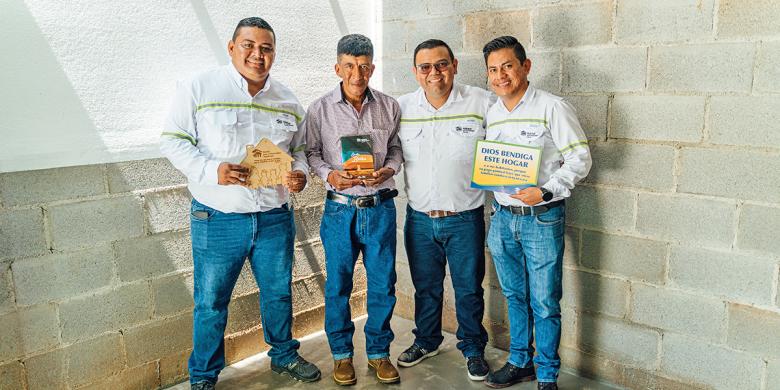
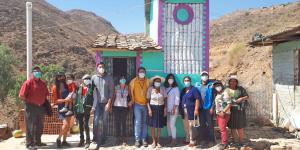
Don Juanito with Habitat staff members who guided him in the construction of his hybrid home.
Every time Guadalupe or one of her children needed access to water, they had to walk to the nearest river to bathe or collect some to bring home. She and her family live in District Nine, in Cochabamba, Bolivia, a peri-urban area of the country where the lack of access to potable water is significant. This is particularly true in informal settlements, where water is mainly provided by small tanker trucks known as aguateros.
Read her story.
Every time Guadalupe or one of her children needed access to water, they had to walk to the nearest river to bathe or collect some to bring home. She and her family live in District Nine, in Cochabamba, Bolivia, a peri-urban area of the country where the lack of access to potable water is significant. This is particularly true in informal settlements, where water is mainly provided by small tanker trucks known as aguateros.
Even when Guadalupe would manage to save enough money to buy water, the aguateros would charge a per-liter price that was more than eight times over market value. Further, the quality of the water was inadequate, as it came from non-potable sources and was not properly stored.
“We would go to the river because we had no bathroom [in our home]. My kids would fall because the rocks were slippery. My daughter can’t see very well and would come home with her knees all torn up. I prayed to God, ‘Please, I need a bathroom,” Guadalupe explains.
Many Bolivian families like Guadalupe’s lack access to water and sanitation services in their homes. In response to this reality, Habitat for Humanity Bolivia designed a water, sanitation and hygiene project to provide vulnerable communities with sustainable bathrooms that would enable them to improve their hygiene while also generating access to water that could be reused, thus maximizing the use of this precious natural resource through innovative and intelligent systems that favor water efficiency.
Through this water recycling program, called Women Building Sustainable Communities, Habitat has provided 60 families in situations of vulnerability with access to water and sanitation, with priority to those with women heads of household. To participate in the project, each family must collect at least 120 plastic bottles and 12 used tires.
Through this project, Habitat has built sanitation modules comprising a toilet, sink and shower and including a water reuse system in the peri-urban areas of districts eight and nine in the southern part of Cochabamba, Bolivia. It has also provided—primarily to women heads of household—the autonomy to make construction improvements on their own homes with training in plumbing, which includes useful skills towards future employment.
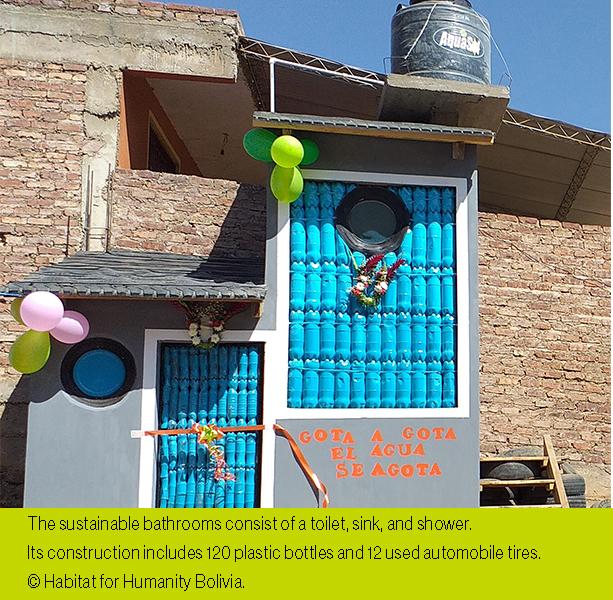
Guadalupe’s new unit will save at least USD 250 and 50,000 liters of water per year, thanks to a more efficient use of resources. She has also received training on family hygiene to reduce the risk of illness.
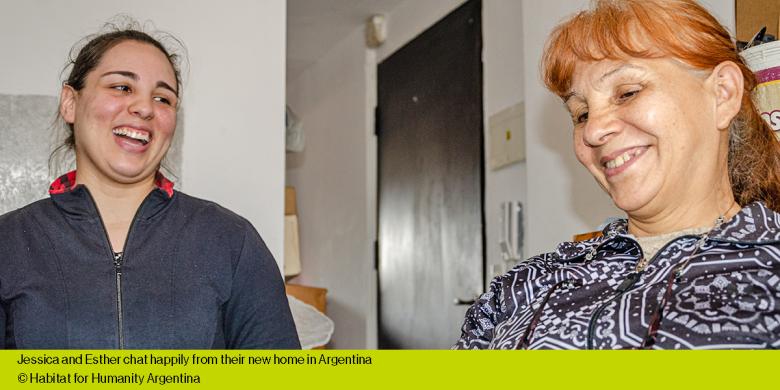
There were many things that Jessica disliked about the apartment where she lived with her mother and grandmother in La Boca, Argentina: the rats that nested in the roof and kept them up at night; the water, which wasn’t potable; the fact that the apartment scarcely protected them from the elements.
Read her story.
There were many things that Jessica disliked about the apartment where she lived with her mother and grandmother in La Boca, Argentina: the rats that nested in the roof and kept them up at night; the water, which wasn’t potable; the fact that the apartment scarcely protected them from the elements.
On rainy days, water would run into the house. “We couldn’t keep up with it… pots and buckets weren’t enough,” Jessica says, remembering how they would collect the water that dripped from the leaks in the ceiling. In the winter the house was exceptionally cold, and in the summer the wood would heat up, making it unbearably warm.
Worse still, the small quantity of water they had access to for the bathroom and kitchen wasn’t potable, so they couldn’t drink it or use it for cooking or washing. Nevertheless, what most bothered Jessica was how dark the apartment was, and how it was unsafe for her mother, Esther, and her grandmother, Amelia.
Esther is visually disabled and lived in constant fear that she would trip over things in the family’s apartment. Amelia, who has mobility issues, would spend most of the day in the darkness of her room.
Tired of living in these conditions, Jessica had spent four years searching for a safer home to move into but could not find anything she could afford that was also in decent condition. Her situation is shared by thousands of Argentineans across the country, where access to formal rentals is one of the main issues cities face. The rental market features a series of requirements that a large proportion of the population—much of which is employed by the informal market—finds challenging to meet.
In Buenos Aires, some 100,000 people must resort to the informal rental market to avoid becoming homeless. They are left with few options, mainly renting a room in a pension house, tenement house, or someone’s home, all of which are outside formal regulations and legal protections and represent risks to the renter’s health and quality of life.
Despite this reality, Jessica and her family refused to give up hope. One day, a friend told her about Habitat for Humanity Argentina’s Estela de Esperanzas building—a Habitat-supervised rental project built nearly 10 years ago in an old hotel and pension house.
The building includes nine apartments where families can access a safe home with affordable monthly payments on a three-year rental contract, which is standard in Argentina’s formal rental market.
The families that live in Estela de Esperanzas have received a gradual subsidy towards the cost of rent, which will be reduced on an annual basis. Additionally, they have the opportunity to participate in employability and entrepreneurship training developed by Habitat Argentina through partnerships with other organizations.
When she heard about the project, Jessica and her family felt overjoyed with the possibility of finally having found a new home. She quickly submitted an official application, and shortly after was informed that she had been selected to move into the building.
“It was the light at the end of the tunnel,” says Jessica.
Her new home has a bedroom, a living room, a full bathroom, a quaint balcony, and many windows that let natural light in from all sides of the home. “Getting out of that darkness and coming into this light was something… something so wonderful!” she exclaims.
The family can now bathe with clean, hot water instead of having to share it. They can cook in the winter without worries, and sleep through the night without being woken by the scratching of rats.
“We want to encourage families that find themselves in this same situation to not lose hope”— Jessica, from Argentina