16 voices
Ernesto Castro, Costa Rica
Costa Rica, Ernesto Castro
An International Perspective on the Cause of Decent Housing
The new millennium had only just begun when Ernesto Castro embarked on the adventure of working with Habitat for Humanity, unaware that this decision would take him around the world and give him a global, multicultural perspective on the housing challenge. After twenty-six years of service, and now serving as Area Vice President, Ernesto joins the 16 Voices that exemplify our work across the region. His story reflects the spirit of Habitat’s staff throughout Latin America and the Caribbean, with a special connection to Costa Rica, his home country and the location of our Area Office.
26 Years of Service to the Cause of Decent Housing
Ernesto learned about Habitat for Humanity through a university classmate who worked as an assistant to one of the organization’s directors. He joined a disaster response project focused on addressing the aftermath of Hurricane Mitch in Central America.
“It’s funny because I had no idea what Habitat was. When I first started looking into it and becoming interested, I thought it was an environmental organization. ... It wasn’t until I started the interview process for an administrative position that I realized it was nothing like what I had imagined.”
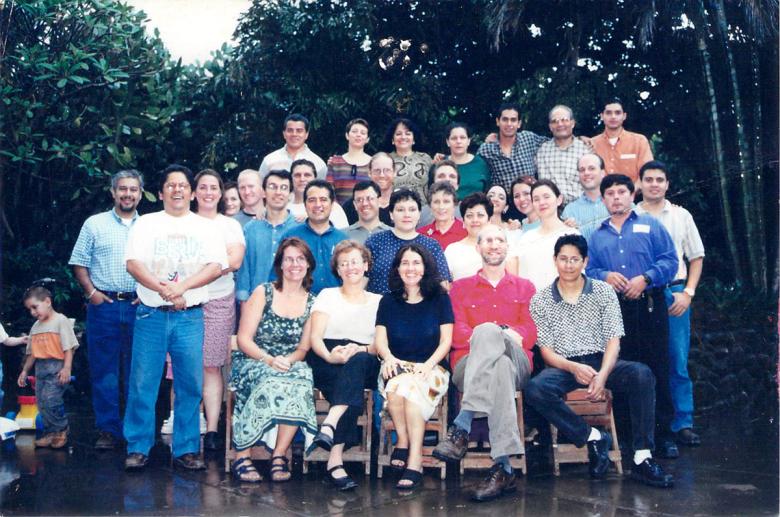
This photograph was taken in 2004 at Torre Nelson’s home during an Area Office staff gathering. Ernesto Castro is the young man in the orange shirt on the right side of the image. Also pictured are Gerardo Morales, Eugenia Salazar, Joselyne Hoffmann, and Juan Ochoa, who continue to work at the Area Office today.
In 2004, Ernesto was selected to manage one of the construction sites for the Carter Work Project in Mexico, relocating there with his wife. That same year, the devastating tsunami struck Thailand, India, Sri Lanka, Indonesia, and other countries. Habitat was seeking experienced staff to support its disaster response efforts, and Ernesto was invited to participate.
“My wife and I had just returned from Mexico to Costa Rica. We had moved into an apartment, painted it, bought furniture, and settled in completely. At first, I didn’t even respond. I thought, ‘We just got back from Mexico. We're not leaving again.’ I didn't even mention it to my wife. A week or two later, Mario Flores contacted me again to ask whether I would be interested in going to Asia-Pacific. I didn’t respond then either. That evening I mentioned it to my wife, and she said, ‘Why not?’ ... We seriously began to consider the opportunity. That was in December, and by March 2005 we were landing in Bangkok, where the Area Office was located at the time.”
That marked the beginning of a journey through multiple projects across the region, eventually leading Ernesto back to his home country, this time as Area Vice President.
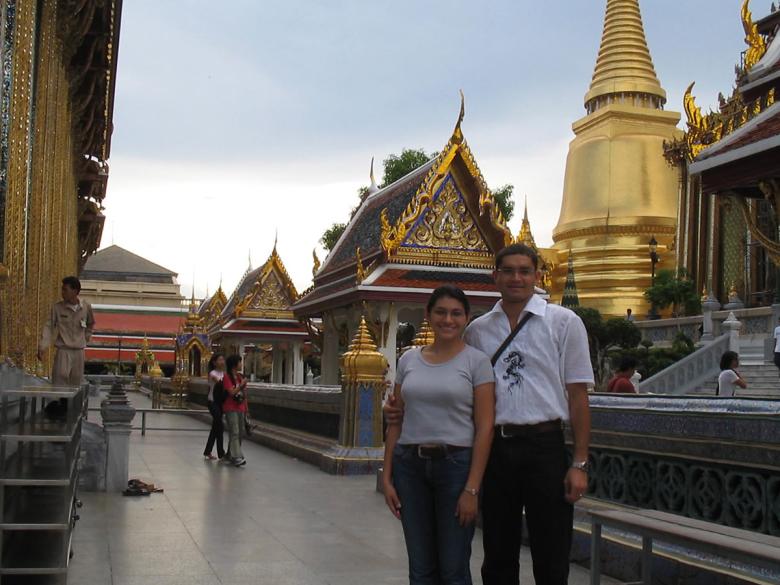
Ernesto and his wife, Roxana, in Bangkok, Thailand.
Ernesto’s International Journey
2000: Hurricane Mitch response from the Area Office in Costa Rica
2004: Carter Work Project in Mexico
2005: Tsunami response in southern Thailand
2006: Carter Work Project in India
2007: Asia-Pacific Area Office, Bangkok, Thailand
2013: Asia-Pacific Area Office, Manila, Philippines
2019: Latin America and the Caribbean Area Office, Costa Rica
Habitat Across Regions and Through Time
Ernesto’s experience across these regions has given him a deep understanding of housing needs and how they vary from one context to another.
“When I think about the levels of poverty in many Asia-Pacific countries and compare them to Latin America, with perhaps the exception of Haiti, poverty levels in Asia-Pacific are significantly higher. Countries such as India, Bangladesh, Nepal, and Cambodia. The contrast is enormous and has a personal impact on you.”
Beyond the numbers, cultural factors play a critical role in every country where Habitat works. While supporting tsunami recovery efforts in Thailand, Ernesto and his colleagues noticed that families were not moving into newly completed homes. After asking why, they discovered that families first needed approval from a Buddhist monk to determine whether the timing was auspicious for moving. They also encountered a design challenge rooted in local culture:
“We were not providing a spirit house, which is a small structure families place outside their homes so that the spirits associated with the property or location have a place to live, avoiding conflict.”
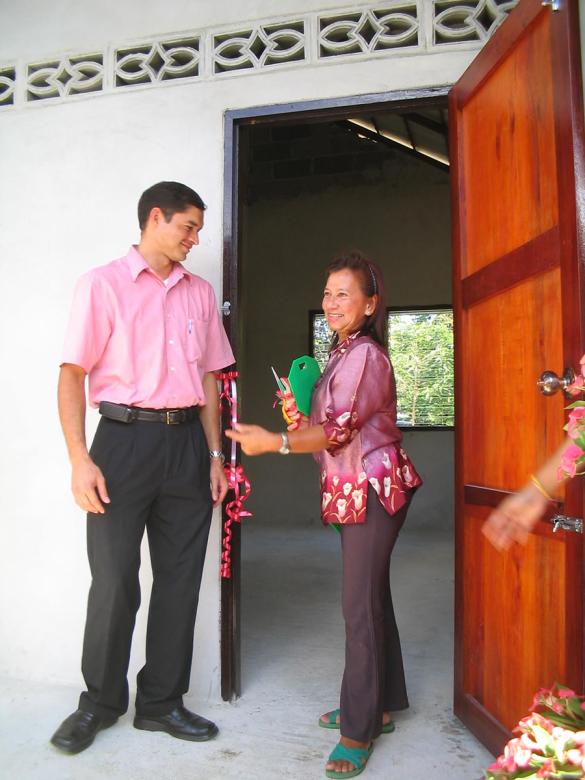
Ernesto at a home dedication ceremony in Khao Lak, Thailand, in November 2005.
In India, Ernesto witnessed the story of a woman who belonged to one of the country’s lowest castes, the Dalits or “untouchables”. When she received her home, she chose not to enter through the front door and instead walked in through the back entrance. This was because, given her family’s social status, they had never entered a house through the front door, and she was still coming to terms with that new reality.
“When she was asked why she hadn't entered through the front door, she said, ‘For generations and generations, my family never had a house like this. From now on, my descendants will have a different future because of this home.’”
The contrast within Habitat is evident not only across different parts of the world, but also throughout its own history. When Ernesto began his career, the organization’s focus was centered on building new homes for families who owned land and were able to pay a mortgage. Over the years, Habitat has expanded its impact and now works on issues such as public policy advocacy, market systems, government relations, and research.
“Sometimes I think about the organization I joined 26 years ago and the organization it is today, and it seems like a different organization, especially in the way we operate. We know that the mission and vision remain the same and have not changed, but the organization’s ways of working have changed tremendously.”
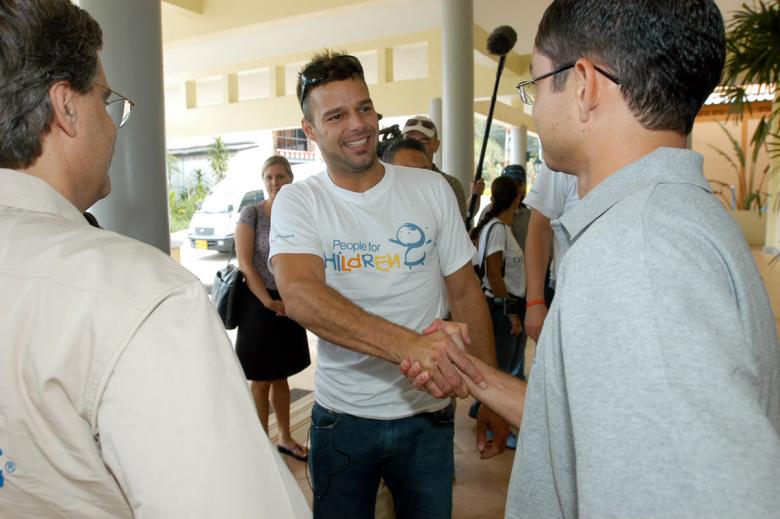
Habitat works with many celebrities around the world. This has given Ernesto the opportunity to meet people such as Muhammad Yunus, recipient of the 2006 Nobel Peace Prize, and Puerto Rican singer Ricky Martin, who appears with him in this photograph taken in Khao Lak, Thailand, in August 2005.
Leader of the Area Office in Costa Rica
In 2018, the position of Area Vice President for Latin America and the Caribbean became available. Encouraged by colleagues within the organization, Ernesto decided to apply and was selected for the role. As a result, he returned to Costa Rica, his home country.
“Obviously, the hardest part about being away for so many years is the family aspect and, from that perspective, it was an opportunity to return and be close to our loved ones, particularly my children’s grandparents.”
From a more strategic perspective, Ernesto has focused his efforts on fostering collaboration among members of the network in order to achieve a regional approach for the organization in Latin America and the Caribbean. Today, our organizational strategy challenges us to expand our reach and find new ways to engage people in the cause of housing.
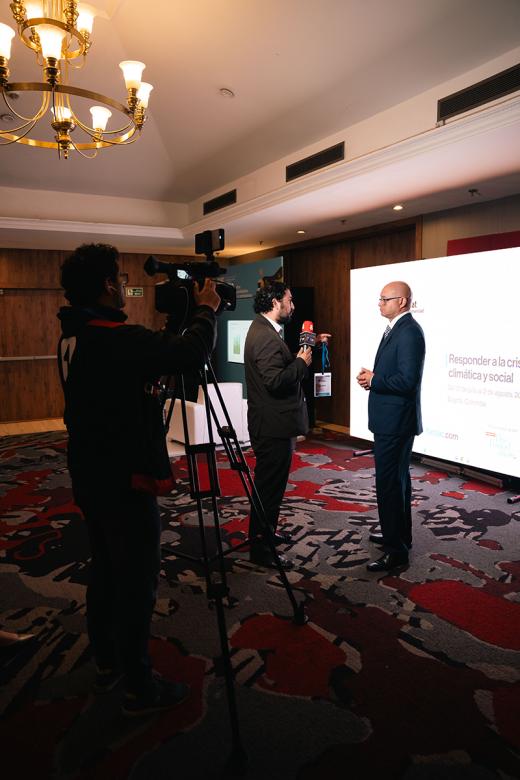
As Area Vice President, Ernesto has represented the organization at numerous events. In this photograph, he is speaking about our Housing Forum, held in Colombia in 2023.
“The housing challenge is perhaps one of the largest, broadest, and most underestimated challenges. I say this because it is a challenge that continues to grow. Housing need around the world keeps increasing at an astonishing pace, despite government programs, private developer projects, or NGOs such as Habitat. The solutions being provided represent only a minimal improvement in conditions compared to the growth of housing need worldwide”.
On a personal level, Ernesto remains deeply connected to the stories of families and community-based work. He has had the opportunity to participate in various volunteer activities and learn about countless stories throughout Latin America and the Caribbean.
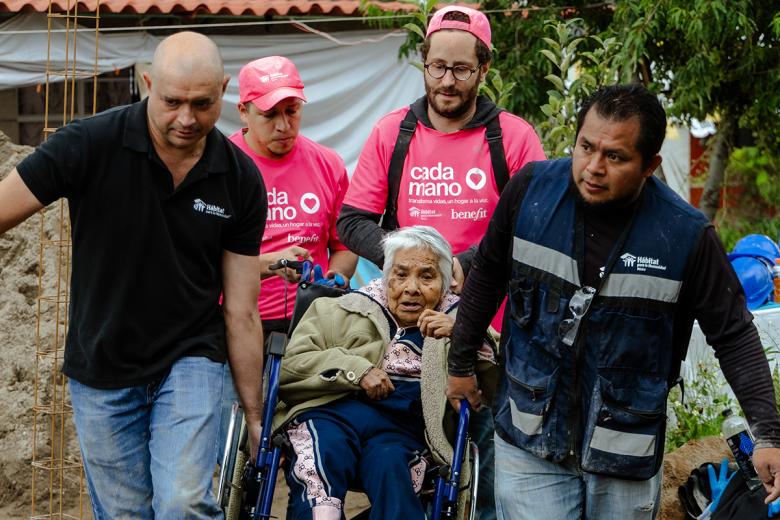
“I remember one particular activity in Tlaxcala, Mexico, where we were working with a group of corporate volunteers from a French company [Benefit]. One of the family members we were supporting used a wheelchair and wanted to see the volunteers and the work we were doing. Obviously, there were no facilities that would allow the wheelchair to reach the construction site. So, several volunteers lifted the wheelchair and carried it closer so that the woman could see the construction process of the home we were helping build. Whenever you work with volunteers, the level of energy, engagement, and desire to be part of something meaningful is always very high.”
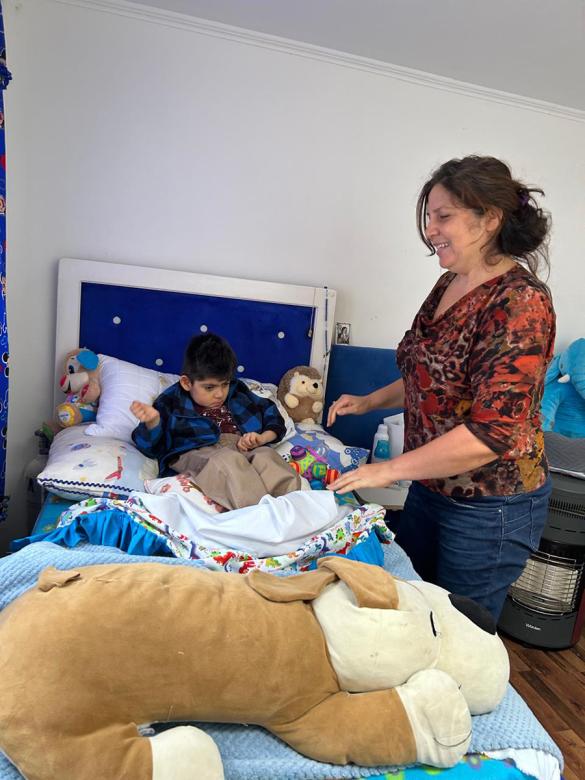
“Another story that had a profound impact on me was the story of Felipe, a Chilean child with extensive needs, brain damage, and many physical limitations. It affected me deeply because I had worked in the organization for many years and could not remember another time when I became emotional to the point of tears. [...] His aunt, who was his caregiver, was talking about the number of days Felipe used to spend in the hospital, and when I asked her when the last hospitalization had been, she paused for a moment and said, ‘More than a year ago. He wasn’t in the hospital at all last year.’ Then I asked, ‘And when was Felipe’s room built?’ And she replied, ‘More than a year ago.’” Felipe’s story was featured in our 2025 Annual Report.
The Role of Servant Leadership Within Habitat
For Ernesto, Habitat for Humanity’s identity is reflected in its culture of servant leadership. From the very beginning of his journey with the organization, he observed how leaders paid close attention to the needs of staff and were always willing to step in and help with support tasks, such as serving meals during volunteer events. This experience shaped the way he relates to his colleagues.
“What I mean by servant leadership is the way organizational leaders carry out activities and interact with people by doing things you would not normally expect from individuals in senior leadership positions. Perhaps the best example is Jimmy Carter and the way he worked with Habitat for Humanity for so many years, actually building, working eight hours or more, collecting trash, and encouraging employees to give even more of themselves.”
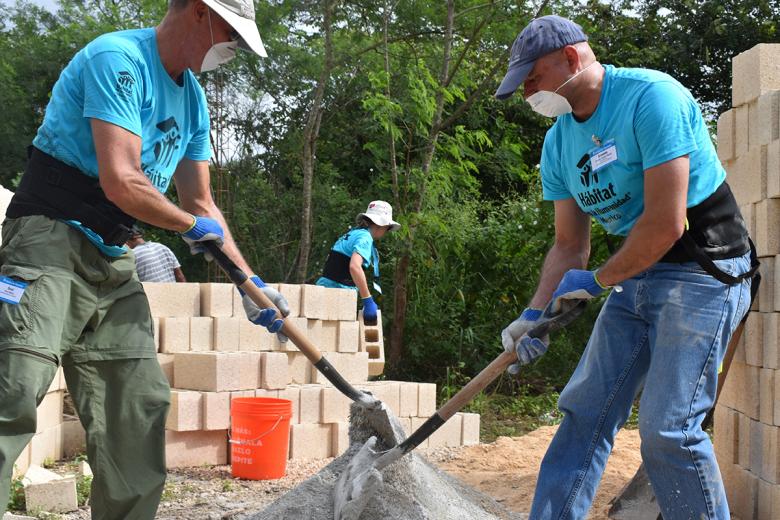
Ernesto has participated in many construction volunteer activities. In this image, he is taking part in a volunteer build in Mexico alongside members of our International Board of Directors.
Ernesto is one of the 16 Voices representing Habitat for Humanity during its 50th anniversary celebration. His testimony reflects the dedication of those of us who work toward decent housing around the world. With that in mind, we asked him what continues to motivate him to move forward with this mission every day.
“A very strong motivation is seeing the impact of our work in the field, on families. I am also deeply motivated by working with different cultures and different people who ultimately share a similar mindset, a common interest, and a commitment to solving housing challenges. So, at the local level, it is the impact; at the organizational level, it is the opportunity to connect and work with people who share a motivation very similar to the one many of us have at Habitat; and at the professional level as well.”
If you or your organization share a passion for impact and for finding common ground through our differences, we have many opportunities and projects that may be of interest to you. Explore our initiatives on our website or contact us.