About us
Asia-Pacific
A world where everyone has a decent place to live
The need for adequate housing solutions in Asia and the Pacific is immense. Quick facts drawn from a 2026 report co-published by the United Nations, the Asian Development Bank and the United Nations Development Programme.
- With rapid urbanization, more than half of the global urban population — over 2.2 billion people — live in this region.
- Asia and the Pacific is also home to 697 million slum residents, or 62% of the global total. These communities experience inadequate housing, insecure land tenure, poor sanitation, unreliable energy access, and heightened health risks.
- Seven of the top 10 most disaster-prone countries are located in the Asia-Pacific region.
Working in a region as diverse as Asia-Pacific calls for collaborative and innovative approaches to complex housing issues. We partner with people of all walks of life to build, repair and finance their homes, innovate new ways of building and financing, and advocate for policies that make constructing and accessing housing easier for everyone.
Who we are
Habitat for Humanity is a movement of people in your local area and around the world, working together to build more prosperous and vibrant communities by making sure everyone has a decent, safe, affordable place to call home.
Since our founding in 1976, together we have helped more than 65 million people globally build their futures on their own terms through access to decent housing. In the Asia-Pacific region since 1983, Habitat has supported millions of people to build or improve a place they can call home. We are active in Australia, Bangladesh, Cambodia, Hong Kong SAR, China, Fiji, India, Indonesia, Japan, Korea, Nepal, New Zealand, the Philippines, Singapore, and Vietnam.
How we work
Our Asia-Pacific strategy addresses the housing needs through three interconnected programs areas.
-
Expected outcomes: stronger community resilience and disaster preparedness; improved housing quality, basic services, and livelihoods; stronger community participation and governance on climate adaptation.
Key interventions:
- Climate-resilient housing through direct provision or technical assistance in design, materials, and construction methods that cut emissions and use nature-based, local solutions.
- Participatory community-based disaster and climate risk management, and capacity building.
- Policy advocacy on disaster and climate resilience at national and sub-national level.
- Housing disaster recovery and resilience, including response, early recovery, and preparedness.
-
Expected outcomes: better access to adequate, quality, secure urban housing; stronger urban community resilience and services; stronger urban governance and policy.
Key interventions:- Formal and informal settlement housing improvement and urban housing planning (including social rent).
- Policy advocacy on settlement, land tenure, tenure security, and urban and city planning.
- Urban community and social infrastructure support.
- Participatory community planning for urban safe shelter, and capacity building.
-
Expected outcomes: greater access to affordable housing finance; a stronger financial ecosystem for low-cost housing; improved affordability and security.
Key interventions:- Market-system housing solutions for affordability, focused on innovative materials and design using local, nature-based solutions.
- Access to housing finance, including government financing and microfinance institutions, with financial literacy capacity building for target households and communities.
- Private sector partnerships for housing finance products and a value chain that supports affordability and sustainability.
We also work alongside hundreds of volunteers each year who come together to help families build a better future through housing. They include passionate youth leaders such as winners of Habitat Youth Solutions grants who created people-centered, sustainable housing solutions.
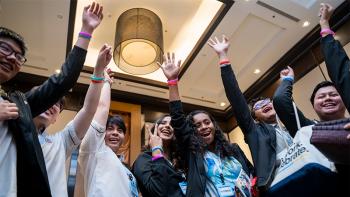
Highlights of the 2025 Habitat Youth Assembly in Cebu, the Philippines, where winners of Habitat Youth Solutions grants were announced.