Call of the accelerators
September 04, 2020
World Humanitarian Day


Small wins
Despite COVID-19 challenges, more than 2 million supporters backed the 2020 Habitat Young Leaders Build.
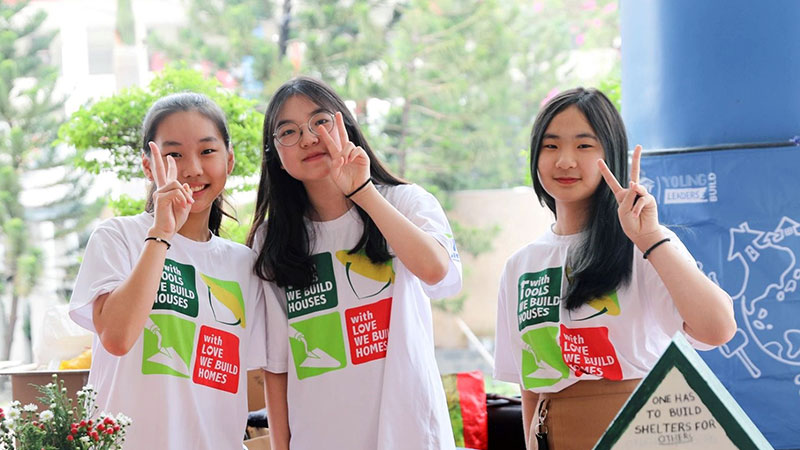
MANILA (Aug. 14, 2020) ― Habitat for Humanity’s Young Leaders Build triumphed in its most challenging season ever to mobilize over 2 million supporters to raise awareness and funds for decent housing in Asia-Pacific. In the most recent campaign that ended on April 25, volunteers and supporters worked on 233 houses and served 3,170 families in 16 countries and one special administrative region.
As with the previous eight campaigns, families worked hand-in-hand with the young leaders. In February 2020, Than Than Aye built a new bamboo house in Bago, north of Yangon, with Japanese youth volunteers. As she has to bring up three children — one of whom has special needs — on her own, she is unable to take on more work. “Our house was totally damaged years ago and we couldn’t rebuild it because of my low income, which was enough only for daily food for my kids,” she says.
Than Than Aye continues about her new home. “I have never dreamt of having this kind of house. This is the happiest I’ve been in my life. Now, my family is safe and comfortable.” With a secure home, Than Than Aye is determined to advance her children‘s education.
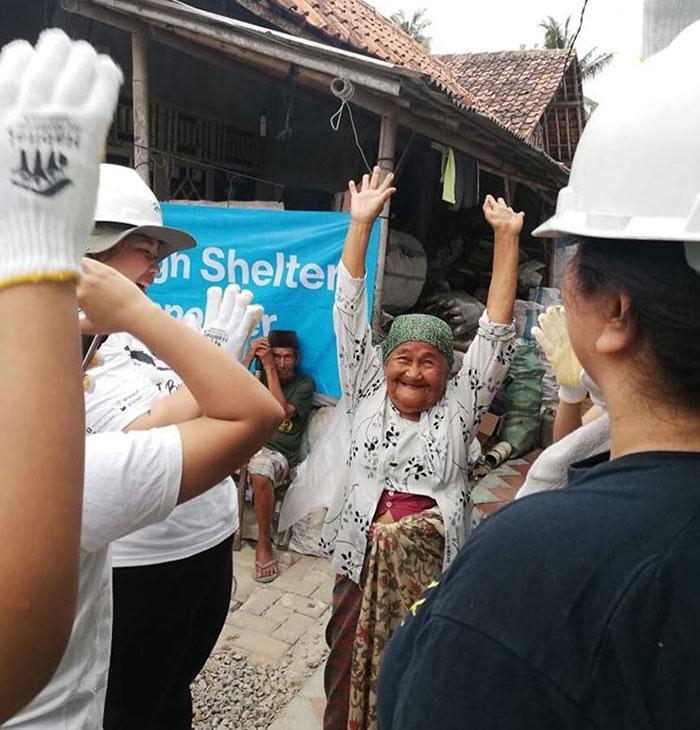
Atun, with raised hands, bonding with the volunteers working on her new home.
In January 2020, Atun, 97, moved into a new home in Mauk village, Tangerang, west of Indonesia’s capital Jakarta. She had spent a third of her life living in a termite-infested house. Her old house was also damp from leaks through the roof when it rained. Rats and other animals would get into the house and contaminate the food.
During the build with volunteers mobilized by Habitat Indonesia, Atun could not stop smiling and often expressed her gratitude. Currently living with two of her children and two grandchildren, Atun enjoys the sunshine and likes to catch up with neighbors during her walk around the village.
Volunteers and supporters have always been the prime movers of the campaign. This year, however, Habitat Young Leaders Build’s culmination activities took a different course. To prevent the accidental transmission of COVID-19 among volunteers, staff and the communities Habitat works in, in-person activities were suspended from February 2020.
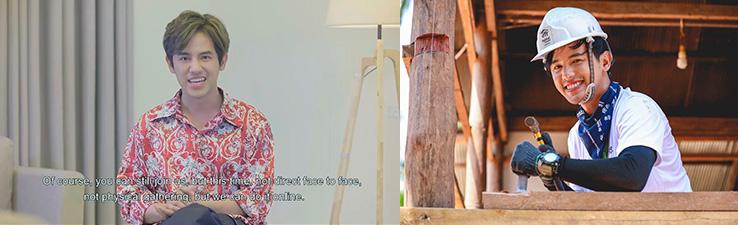
In a video (left), Habitat Cambodia’s Youth Ambassador Vy Yaro urged supporters to stay safe and show online support instead of building onsite.
COVID-19 response
Instead of building houses, many Habitat volunteers turned to online activism to help their communities cope with COVID-19. Vy Yaro, Habitat Cambodia’s Youth Ambassador, was slated to build a home in Cambodia on the campaign’s culmination day. Instead he recorded a video to check in with fans and remind them to follow safety protocols and public health recommendations.
Cambodian volunteer Prum Chanvattanak channeled his fundraising efforts in support of Habitat into producing a video to remind his peers to stay at home and observe social distancing as well as provide tips to reduce stress. “I hope the video will be helpful for our community during COVID-19. I believe that this is the power of youth,” he says.
In Thailand, members of Habitat school clubs raised more than 43,000 baht (about US$1,380) in a week through a virtual fundraising challenge. They appealed to their peers to support families in need of decent housing, particularly those whose house construction had to be postponed because of the pandemic. Through homemade videos, volunteers shared their experiences building alongside families and supporting Habitat’s mission.
Students from Don Bosco Technical Institute were among the youth who supported Habitat India’s initial response to COVID-19 by raising US$44,851. The funds enabled local partner organizations to distribute health kits and family essential kits to 2,903 families in various communities where Habitat India has implemented projects.
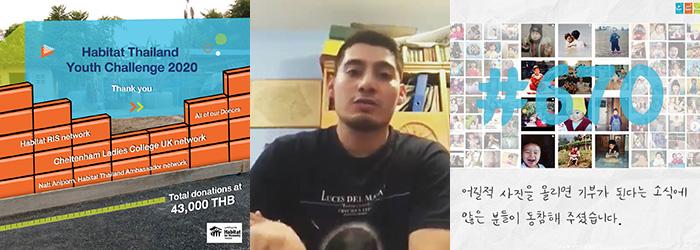
(From left) Habitat Thailand’s thank-you to supporters; Jose Daniel from India shared a video of his volunteer journey #MyBuilDiary; and Habitat Korea’s fundraising initiative via childhood photos.
Toward the close of the 2020 Young Leaders Build campaign, the #SafeHomeChallenge drew youth support on social media. By posting a series of photos, the youth raised awareness of a safe home as the first line of defense against the coronavirus. By the end of June, there were more than 1,000 unique posts shared by individuals in over a dozen countries in Asia-Pacific as well as in Hong Kong, the Netherlands, the U.S. and Zambia. At least 1.46 million users have been reached on social media. The challenge is also part of Habitat’s global fundraising initiative Homes, Communities, Hope + You
#myBuilDiary
Adapting to the new normal, some supporters highlighted their own volunteer experiences and journeys with Habitat to raise awareness of the need for adequate housing and engage more young people.
Using the hashtag #myBuilDiary, students used various media to share their insights. “Even if you don’t have any idea about construction, that’s not a problem at all,” Jose Daniel says in a video he uploaded for the campaign. He first built with Habitat India in 2016 in JJ Colony, New Delhi, and has volunteered multiple times over the last five years.
Another volunteer, Ishita Agarwal, a student of King George V School in Hong Kong wrote, “Knowing that I was able to make a physical difference in someone’s life helped me realize just how real the housing crisis really is. Because I am fortunate to not have to worry about living in a place that is unsafe, that doesn’t mean I can ignore. I still have a duty to do my part and make sure that other people are able to experience living in a safe and clean house.” In July, she recorded a video to encourage other young people to volunteer.
Another repeat volunteer, Nepali business student Miraj Pokhrel, says: “Back in May 2011, I got the chance to volunteer with a Global Village team from Habitat Ireland. I helped build two houses in Budhabare.” He spent the next three years as a volunteer for Habitat Young Leaders Build, mobilizing local youth for a sanitation campaign led by him in Bhadrapur. He explains his commitment to the HYLB campaign is due to his enthusiasm for helping and building up other young people.
In Korea, supporters uploaded their childhood photos taken at home to highlight the importance of having a safe place in which to grow up. Every uploaded photo featuring the campaign’s official hashtag brought in a donation of US$1 by a local café that partnered with Habitat Korea. The funds enabled Habitat Korea to support children in need of a decent home
Before COVID-19
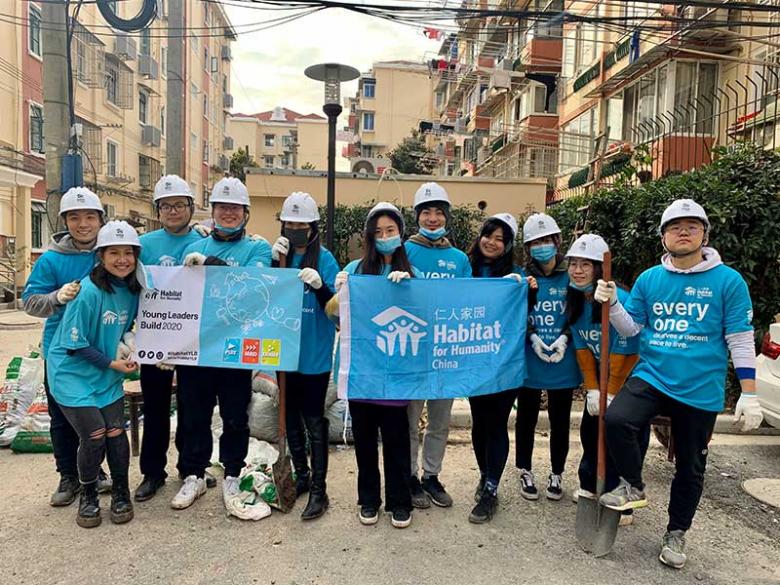
Habitat China did its first live stream of youth volunteers working with low-income families and communities.
Soon after Habitat Young Leaders Build was launched in December 2019, some in-person volunteer activities took place in several locations:
- Bangladesh: MetLife volunteers joined four families at a house dedication ceremony in Kaliganj, Gazipur district, in December 2019. MetLife supported home construction with funding and volunteers.
- China: Habitat China launched its first live stream on Weibo, a Chinese Twitter-like online networking tool, and Instagram during the campaign culmination. The video featured Habitat China’s urban projects and youth volunteers who worked with low-income families and communities, and called for more youth participation.
- Fiji: local volunteers participated in clean-up activities and various training sessions on gender sensitivity and disaster risk reduction and resilience.
- Indonesia: Habitat partnered with university students to raise funds and to help build homes alongside families in need.
- Japan: 36 students from Habitat campus chapters across the country took part in the first-ever training on the Sustainable Development Goals. During the two-day session supported by DENTSU Scholarship Foundation, they planned individual and group projects to make their communities more sustainable.
- India: the slew of activities organized with young leaders included The Umbrella campaign that sought to raise awareness in communities on preparing for floods. Habitat India also trained participants through the HYLB Leadership Academy.
- Myanmar: a team of 14 volunteers from Japan helped build two homes with local families during the third Asia Build.
- Philippines: Habitat worked with youth including those who have been trained in the Habitat Young Leaders Build’s Leadership Academy, the US Peace Corps volunteers in the Philippines, and members of campus chapters as well as other local youth organizations in community clean-ups and awareness-raising events.
- Vietnam: students of Canadian International School, The American School, International School in Ho Chi Minh City — American Academy and the Rainbow Youth Club raised awareness and funds for Habitat through charity sales and booths.

Despite COVID-19 challenges, over 2 million supporters backed the 2020 Habitat Young Leaders Build.
Off
Small wins
Wells Fargo, Habitat India support 120 families hit by Cyclone Amphan
Homes, Communities, Hope + You
Habitat’s global fundraising initiative addresses dual health and economic crises caused by the pandemic.
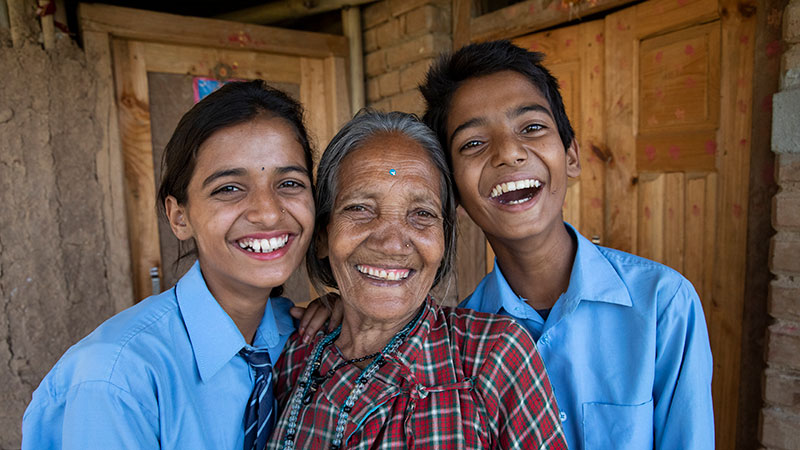
MANILA (July 27, 2020) — Amid the pandemic’s unfolding dual crises, life has become even more challenging for many low-income families. Housing is the first line of defense against the coronavirus. Yet one in two people in the Asia-Pacific region lives in overcrowded slums, lacking access to water and sanitation. This region is also home to half the world’s poor — living on US$1.90 or less a day — who risk falling over the edge into chronic poverty.
Habitat’s response to the pandemic addresses both the health and economic fronts. Through its first global fundraising initiative, Homes, Communities, Hope + You, Habitat welcomes all supporters to help families weather the crises and communities to emerge stronger.
The campaign is anchored by four areas: healthy homes; access to secure shelter; housing market and economic recovery; and, advocacy for adequate, affordable housing.
“Housing conditions can literally mean the difference between life and death,” said Jonathan Reckford, CEO of Habitat for Humanity International. “In any disaster, it is those with the least who are impacted the most. These are the families with whom Habitat partners. Now, more than ever, we need to make sure we are ready and able to answer the call.”
In the Asia-Pacific region, Habitat has launched various initiatives to raise awareness, increase support, and establish partnerships with organizations and corporations. A brief round-up is as follows:
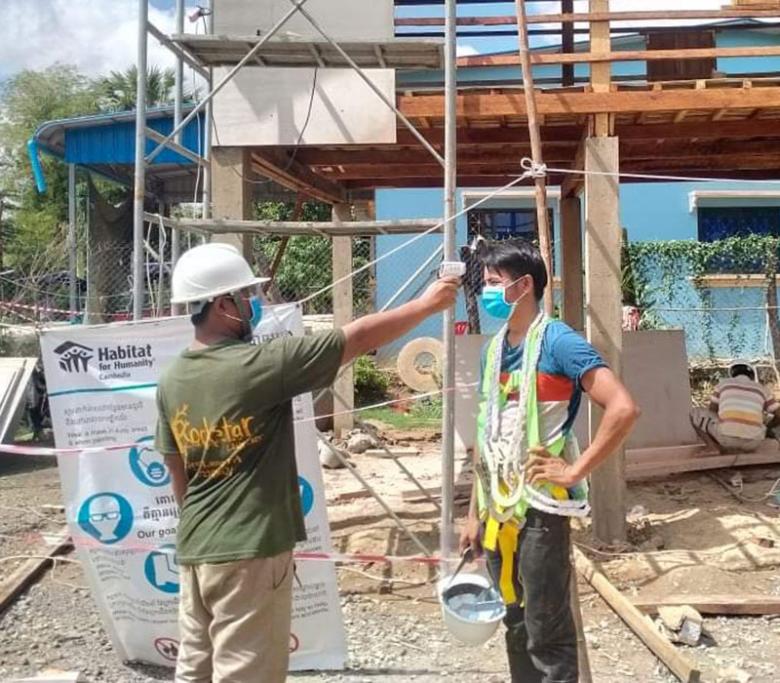
Temperature-taking is among the safety measures adopted by Habitat Cambodia for construction workers and families. Photo: Habitat Cambodia’s Facebook page.
Healthy homes
Safety protocols for workers and future homeowners were implemented with the gradual resumption of construction activity in Cambodia from late May. Habitat Cambodia worked together with the local skilled workers to develop locally available personal protective equipment such as face shields fitted into construction helmets and reusable face masks when working onsite. Handwashing stations and disinfectants are also readily available on worksites.
In addition, future homeowners attend awareness-raising lessons on COVID-19 prevention, have their temperature taken regularly, assist Habitat in ensuring the new safety protocols are consistently practised by the skilled workers, and prevent unauthorized or non-essential visits to the worksite.
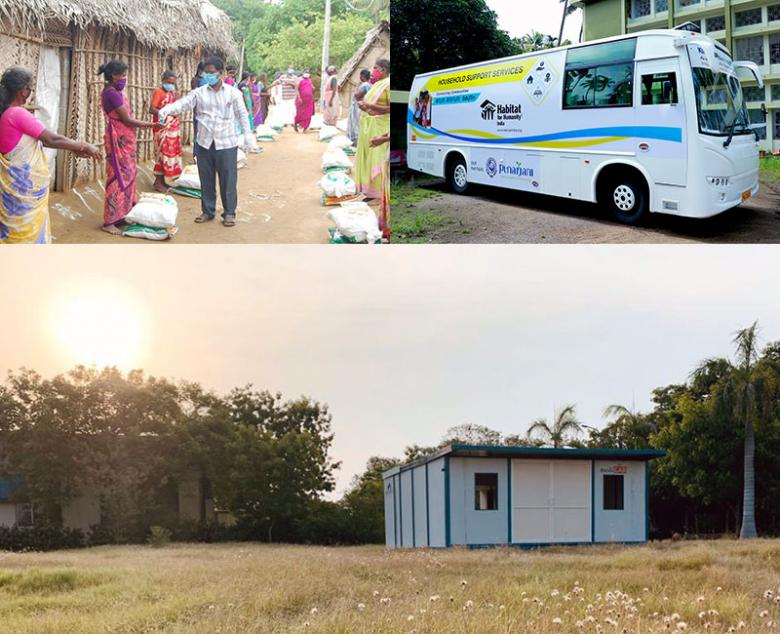
(Clockwise from top left) Distribution of hygiene and family essentials kits, and the provision of mobile housing support services in India; a portable micro hospital unit developed by startup Modulus Housing. Photos courtesy of Habitat India and Modulus.
To reduce the transmission of COVID-19 in vulnerable communities, Habitat India has distributed over 192,500 hygiene as well as family essential kits, assisting more than 774,800 people as of July 20. It has also launched a mobile unit in Kerala state that offers more than 50 types of housing support services that aim to improve the housing conditions of about 300,000 people. Direct financial assistance such as cash transfers have been provided to over 24,200 families in India to enable them to stay in their homes.
With funding from Habitat’s Terwilliger Center for Innovation in Shelter, Indian startup Modulus Housing has developed a mobile unit that serves as a temporary medical facility in Kerala. Modulus was among the startups that joined the Terwilliger Center’s ShelterTech Accelerator program in 2019. Known as mediCAB, the 10-bed facility can be set up in two hours and is portable. The 10-bed micro hospital will be launched in partnership with Sree Chitra Tirunal Institute for Medical Sciences and Technology in Wayanad district, Kerala. After it is set up, the local government will assume operations of the facility.
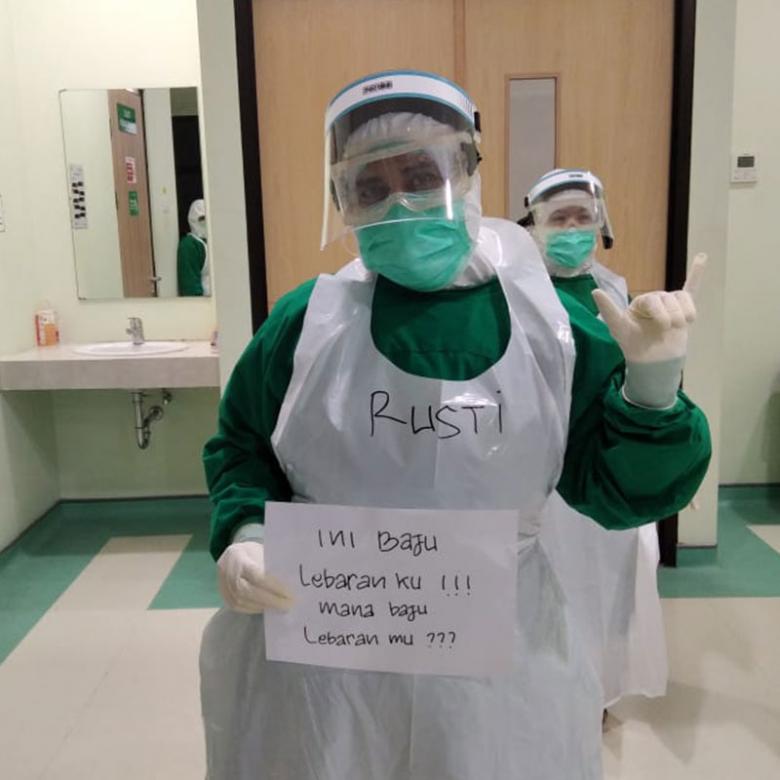
Rustiana is among 1,600 frontline workers who are provided with temporary accommodation under Habitat Indonesia’s campaign. Photo courtesy of Habitat Indonesia.
After Indonesia declared COVID-19 to be a national disaster on April 13, Habitat Indonesia launched a campaign to provide temporary accommodation for medical workers in the capital Jakarta and Surabaya. Although doctors, nurses, cleaning staff, among others, work hard to battle the pandemic, many could not have adequate rest as they avoided going home to keep their loved ones safe. To date, more than 1,600 medical workers have benefited from this initiative.
Advocacy
In May, an opinion piece published in Devex highlighted the challenges of preventing the spread of COVID-19 in resource-poor areas. The government, the private sector, financial institutions, and civil society need to collaborate to ensure everyone has a decent place to fight the pandemic, Enid Madarcos, Habitat’s urban policy manager for Asia-Pacific, argued.
Meanwhile, Habitat India’s managing director Rajan Samuel penned an article calling for decent shelter to be a bridge between lives and livelihoods during COVID-19.
Jessan Catre, country lead, Philippine Shelter Venture Lab, Habitat for Humanity’s Terwilliger Center for Innovation in Shelter, highlighted an important segment in the housing market. In his piece for Thomson Reuters, he asserted informal housing markets can make or break a recovery from the pandemic and recommended key actions to keep low-income households at the center of governments’ responses.
Between May and July, Habitat also organized a three-part “Our Homes, Our Health” webinar series in collaboration with Purdue University and Penn State University. Coming from different sectors, panelists tackled issues on the implementation of stay-at-home measures in the Global South; media advocacy; systemic and emerging risks on global health and housing; interdisciplinary frameworks for technical solutions; and mitigation strategies drawing on vulnerable groups’ experiences.
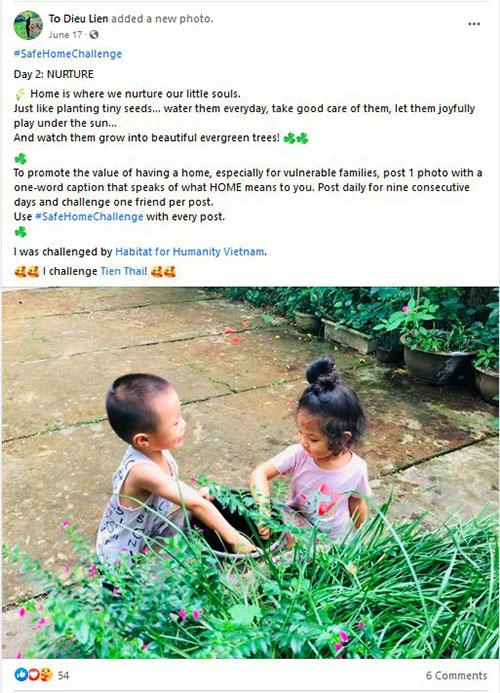
A post from Vietnam in response to #StayHomeChallenge.
In June, the #SafeHomeChallenge campaign was launched to engage youth supporters in raising awareness of a safe home as the first line of defense against the coronavirus. By the end of June, there were more than 1,000 unique posts shared by individuals in 18 countries as well as Hong Kong. At least 1.46 million users have been reached on social media.
In addition, short video testimonials on Habitat’s COVID-19 response around the world have been released. Among those featured were Habitat Nepal’s architect Tripti Mahaseth as well as Habitat’s Asia-Pacific operations director Anna Konotchick and senior manager for housing and land policy Rebecca Ochong.
For over 35 years, Habitat has been working to build homes, communities and hope. The need for safe, adequate housing that we work so hard to meet every day will only grow during the COVID-19 crisis. Now more than ever, we need you. Together, we can find our way forward.
We are grateful for all your support. To contribute financially, please visit habitat.org/donate. To find out more about Habitat’s work in the Asia-Pacific region, please subscribe to our newsletter or visit habitat.org/asiapacific. Connect with us on Facebook, Twitter and Instagram.
Off
Homes, Communities, Hope + You
Sakina the breadwinner
Sakina could start building a better life for her family after becoming a Habitat homeowner in Bangladesh.
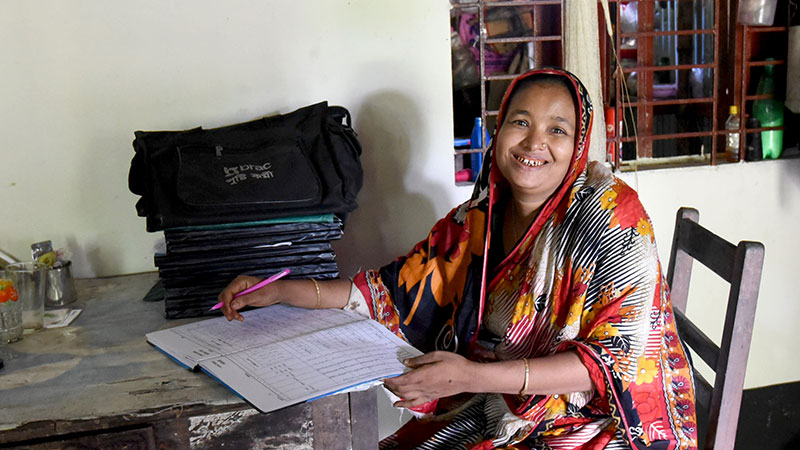
Sakina has come a long way since she was a young bride of 17. She took on the responsibility of providing for her family after her husband had a stroke in 2011. Now she earns about 3,500 Bangladeshi taka (US$40) a month as a community health worker in pregnancy and newborn care with a national development organization.
In the early days of her marriage, home was her parents-in-law’s house in Bhandarikathi, a village in Barisal district, south-central Bangladesh. When her two brothers-in-laws started their own families after marriage, the house became more crowded.
Sakina and her husband Alomgir were able to have their own living quarters before their first child was born. The traditional house was given by her husband’s family. It had bamboo pillars and walls made of elephant grass and corrugated galvanized iron sheets for its roof.
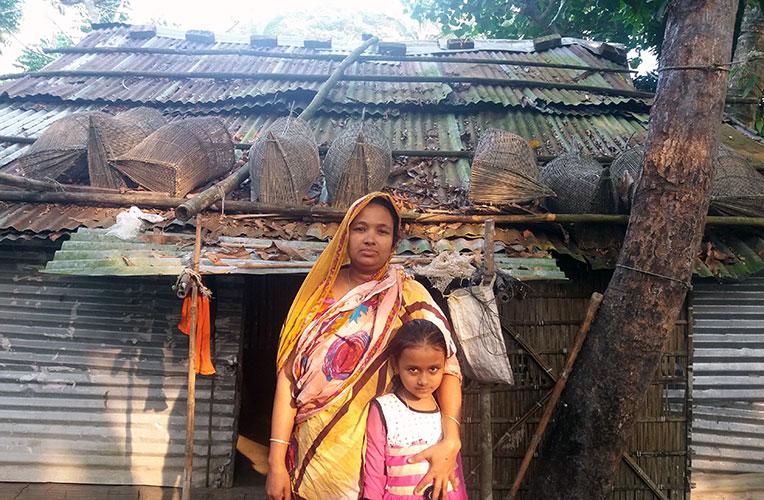
When her family was living in their old house, Sakina had to send her son and daughter Sadia (right) to their neighbor’s house whenever it rained heavily.
The family’s income used to come from a tea stall that Alomgir ran in the local market. His business was doing well until he had a stroke and became partially paralyzed. Sakina struggled to pay for her husband’s medical bills while caring for their son Rakib, then aged 10, and their one-year-old daughter Sadia.
After a relatively long period of treatment, Alomgir, 48, has recovered to a certain extent but he can neither exert strength nor work for too long. By making or repairing fishing nets, he can make about 400 to 500 taka (US$5-$6) a month.
Sakina recalls: “We had quite a nice home for several years. However, as time went by, our home became worn out, rusty and broken in several places. We needed to repair the old home very often, especially during the monsoon, to stay dry.” During heavy rains, the couple had to cover all their belongings with polythene sheets and send their children to a neighbor’s house for safety.
Alomgir would also get colds and coughs and he was not the only one. “With a damp floor, poor air and inadequate light, the house was unhealthy and our kids would get sick,” says Sakina.
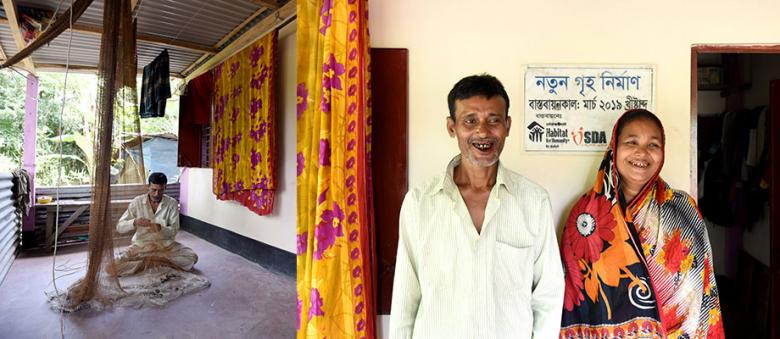
Alomgir makes and repairs fishing nets at the house that he shares with Sakina (right) and their two children. Photos (main and above): Habitat for Humanity Bangladesh/Pablo Amos Halder.
It was only after she became a Habitat homeowner in May 2019 that she could focus on the future. About three months after moving in, Sakina constructed a room at the back of the house for her son Rakib, now 19, who is studying sociology in a local college. Her daughter Sadia, 9, is a student in the third grade.
“This new home has improved our health and significantly reduced medical costs. My dream is for my kids to complete their education and be established in life,” Sakina shares. “This house has given me the foundation to build a better life for my family,” she says, adding that she is happy and confident about the future.
Sakina’s family is among five families in Bakerganj upazila, Barishal district, who built homes under the partnership between Habitat Bangladesh and the Ahmad Family Fund. That project also supported a total of 40 home renovations and installation of three deep tube-wells. Since October 2017, the partnership has enabled more than 380 families in five districts to improve their lives through decent housing and adequate water and electricity access.
In two decades of working in Bangladesh, Habitat for Humanity has partnered with over 1,200 families to build homes, communities and hope. Visit habitatbangladesh.org for more information or follow facebook.com/HabitatBD
Off
The breadwinner
Meet our families
Across the Asia-Pacific region, families such as Naresh’s partner with Habitat for Humanity to build or improve a place they can call home.
Teaser title
Meet our families
I continue to stand tall
Despite her difficulties and health issue, Kimchheng can build a better life with her son in a decent, secure home.
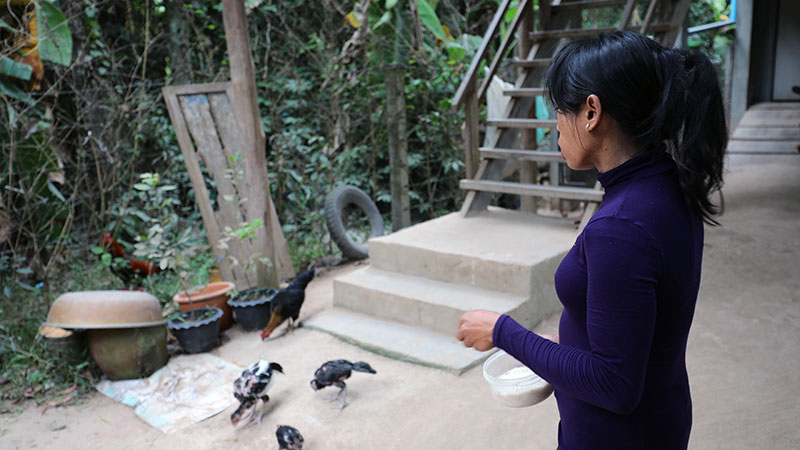
Kimchheng knows how tough it is to be a single parent on low income. “When my husband died, I went through many difficulties,” the 40-year-old fruit seller recalls. “But I continue to stand tall.”
She has been raising her son Tibe on her own since he was two years old. He is now 18 and they live in a house that Kimchheng helped build in 2017. Since then, she has found refuge in her home in times of sickness. She is also more ready to welcome visitors to her home in Kandal province, Cambodia. This was not the case in the past.
For more than a decade, they had lived in a small house with mud floor and a leaky roof. A light rain would turn the floor into a muddy puddle. When it rained heavily, water would seep in and rose knee-high. Both mother and son also suffered from diarrhea.
Kimchheng says: “In our old house, I felt fearful whenever I had to leave my son and our possessions behind to go to the market. The old house wasn’t secure because we didn’t have a proper door and the walls had holes.”
Despite such living conditions, Kimchheng could not afford to build a new house. Most of her US$25 monthly earnings from selling fruit in a nearby market went to Tibe’s education and their daily needs including food.
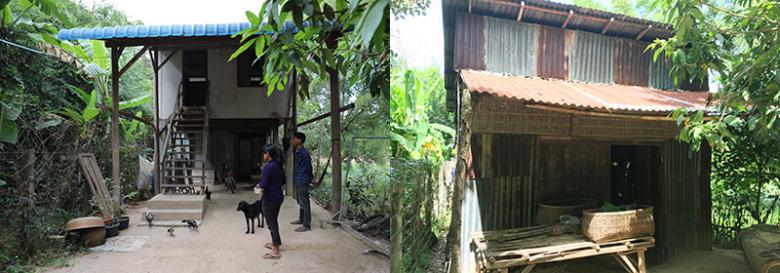
(Left) Kimchheng and her son Tibe in front of their Habitat house; (right) their old house that leaked during heavy rains. Main and left photos: Habitat for Humanity Cambodia/Soung Bunna.
Her opportunity for change came when she partnered with Habitat for Humanity Cambodia to build a new home. Together with Habitat volunteers and local skilled workers, Kimchheng constructed a wooden house on stilts, in the traditional style.
She also learned about ways to improve her family’s health through the water, sanitation and hygiene training by Habitat Cambodia. With access to grid electricity, she no longer has to use her motorbike’s battery for power.
Kimchheng, who is living with AIDS, gets her medicine from the local health authorities. Her neighbors would bring her food whenever she is too sick to work. “With this house, we feel more secure. I don’t have to worry about our belongings or about my son’s safety,” she explains. “When it rains, we know we’re in a safe place.”
Tibe has chosen to study English after school. Both mother and son smiled as they looked at each other. Kimchheng says: “Having our own home has eased my burden. I’m able to save money now so I could set up a fruit stall near our house. As for my son, he can focus on his studies. He can be a mechanic or an electrician.”
Kimchheng and Tibe are among 578 vulnerable families who partnered with Habitat for Humanity Cambodia to build safe, decent homes in the “Chapadem Chivet Thmey” (Khmer for New Start, New Life) project in Phnom Penh and Kandal, Siem Reap and Battambang.
Homeowners also improved their awareness of water, sanitation and hygiene standards, learned about home maintenance, and received livelihood skills training. Funding support for the project that ended in June 2019 came from Australia’s Department of Foreign Affairs and Trade through Habitat Australia.
Since 2003, Habitat Cambodia has enabled over 90,000 families to build strength, stability, and self-reliance through shelter. Find out more at habitatcambodia.org or follow facebook.com/HabitatCambodia1/
Off
Standing tall
Embracing Independence
Shirin is actively creating a better life for her family by rearing goats and tending to her fruit garden. “Even at home, I can do some work and raise my family.”
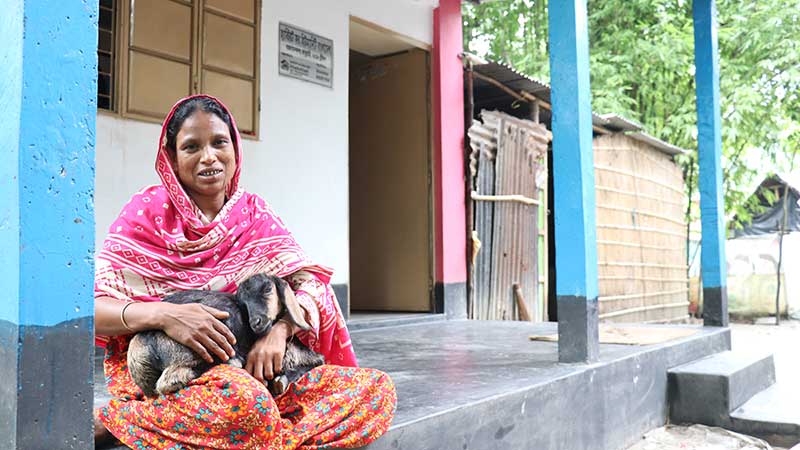
Shirin, 38, remembered the first time her family of four entered their new home in January 2019. “I cleaned the room, brought in our clothes stand and belongings, and offered prayers and thanksgiving to the Almighty for this happy moment.”
Shirin, her husband and her younger children live in Taragai village, Mymensingh district, north of Bangladesh’s capital Dhaka. Her previous house was made of thatch and bamboo and salvaged tin sheets. During the annual monsoon season, rainwater would leak through the roof and walls, making the earth floor muddy.
In a safe and secure home, Shirin is actively creating a better life for her family. While her husband Mostofa, 45, goes to work as a bus conductor, she is busy tending to her fruit garden around her house. In summer, she can harvest jackfruit, mango and pomelos.
At the back of her house, she keeps two goats and a pair of pigeons that will eventually be sold in the local market. A goat can fetch up to 750 taka (U$9) while a pair of pigeons can be sold for up to 300 taka. After moving in, her family income has increased to 8,000 taka a month from 6,000 taka previously. “Even at home, I can do some work and raise my family,” Shirin shares.
“I want my children to get education and have full lives,” she adds. Her sons Mobaraq, 8 and Akbar, 12, are studying in local schools. Her daughters Tashlima, 18, and Tanjila, 21, are already married and live in other villages in Mymensingh with their own families.
Since October 2017, the Ahmad Family Fund and Habitat for Humanity Bangladesh have enabled 13 families including Shirin’s in Mymensingh to build strength, stability and self-reliance through shelter.
Habitat first began working in Bangladesh in 1999 with its first project in Mymensingh. Since then, more than 1,200 families have been supported with decent homes, housing renovations, community toilet and bathhouses, walkways and drainage systems and a series of capacity building and awareness raising training. Find out more at habitatbangladesh.org or connect via facebook.com/HabitatBD
Habitat for Humanity Bangladesh, family
Off
Embracing self-reliance