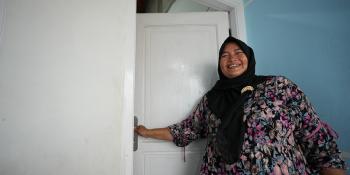
Tanjung Kait is recognized by the Government of Indonesia as an example of collaborative settlement transformation. Habitat for Humanity Indonesia worked with local communities, government agencies, donors, academics, and other partners to create safe and sustainable housing with families who had lived for generations without formal land ownership.
A total of 107 families in Tanjung Kait had built their houses with the permission of the previous owners of the land. They have long faced the threat of flooding. Among them are Komariyah, her husband Ahmadi and their three children, who have been living in the community for over 20 years. “When it flooded, we had skin rashes and diarrhea.”
Although she wanted a better place to live, she could not leave Tanjung Kait. “Our livelihood here is quite decent. My husband is a fisherman, so it would be impossible to move inland. If we live in any other village, we would be far from our source of income.”

Komariyah’s husband Ahmadi was greeted by their daughter after he returned from a fishing trip.
Their family and their neighbors are among the more than 1.1 billion people around the world who live in slums and other informal settlements, and that figure continues to rise. Residents of informal settlements have very limited access to basic services such as clean water, sanitation and electricity. The poor living conditions are a physical manifestation of inequities holding back far too many families and communities.
Home Equals
In 2023, Habitat for Humanity and partners launched Home Equals, a five-year global advocacy campaign to change policies at the local, national, and regional levels so that residents of informal settlements have a safe, secure place to call home. In the Asia-Pacific region, five Habitat entities in Australia, Cambodia, Indonesia, Nepal and Vietnam joined the campaign to pilot advocacy and programmatic interventions to help upgrade housing in informal settlements.
Habitat for Humanity Indonesia’s Home Equals project in Tanjung Kait worked to improve access to adequate housing in informal settlements through policy and systems change. The project helped strengthen long-term residents’ land tenure and enabled the families to upgrade their community facilities and houses.
In Indonesia, Habitat advocated for the development and implementation of regulations to speed up the provision of decent homes and encourage use of village funds to provide adequate housing. In early 2024, this unlocked an initial US$185,333 in government funds for housing programs—potentially benefiting 14,760 people.
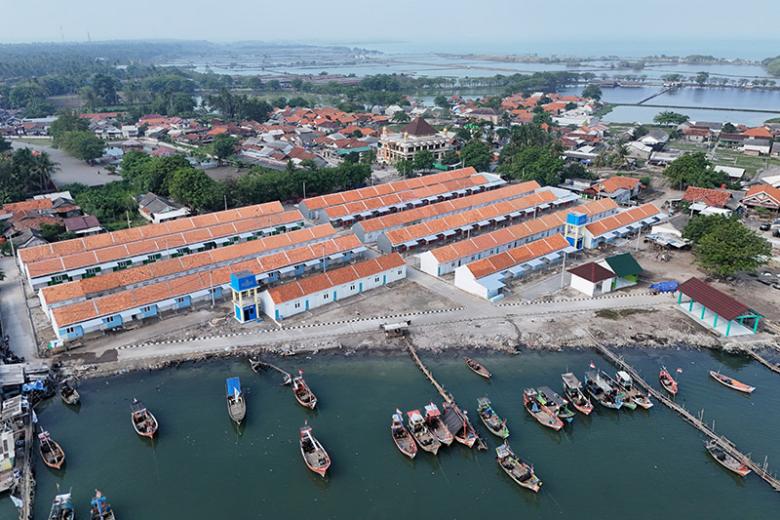
Aerial view of Habitat Indonesia’s Home Equals project in Tanjung Kait fishing village.
Komariyah became a community leader after she was trained in safe shelter principles. Together with other community members, she joined consultations and created a community action plan. It detailed steps to formalize each family’s ownership of their land, helping to overcome the lack of financial resources to buy the land and process documents to certify their ownership. To bridge the gap, Habitat Indonesia worked with KOMIDA, one of the largest microfinance institutions in the country, to customize an affordable loan scheme that allowed 87 families to each buy a plot of land and cover land certificate costs.
Unlocking land tenure security
By October 2024, 110 families—including Komariyah’s—secured legal land ownership and unlocked US$645,161 in government funds to support their access to financing opportunities for buying the land they have been living on. “Finally, we own our land,” Komariyah said.
To ensure long-term impact, Habitat Indonesia partnered with government officials to develop disaster-resilient housing guidelines and promote inclusive land ownership with both the names of husband and wife included in land certificates.
Empowered participation is at the core of the project. Community members and partners worked alongside government officials to clear the land to prepare for the construction of new, resilient housing. The government, along with private donors, built sustainable road infrastructure, drainage, clean water utilities, electricity networks, green spaces, public facilities, fish-collecting kiosks, and wave-breaking structures.
“We have never had a decent house for three generations. We now have one that’s comfortable and safe for the family,” Komariyah said. “A house is essential. It’s where we live, a shelter from heat, rain, and wind. It’s a place that protects us.”
Get involved
Across the Asia-Pacific region, about 700 million people live in slums or informal settlements. Help us close the world’s housing gap by speaking up for housing. Learn how.