Cool ideas for climate resilience
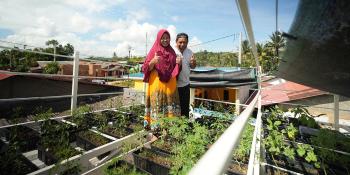
A rooftop garden that provides insulation against heat is among initiatives under Habitat for Humanity Indonesia's passive cooling project on Batam island.
DONATE NOWAs urban temperatures rise, vulnerable groups including stay-at-home mothers, older people, young children and outdoor workers are disproportionately affected. Besides health risks, heat stress reduces labor productivity and capacity.
Habitat for Humanity Indonesia is currently implementing a passive cooling project in Batam, the largest city in Riau province, with potential for scaling there and in other areas in Indonesia. Families partner with Habitat Indonesia to retrofit existing homes or build new homes with passive cooling designs, supported by performance testing by a local university and technical input from partners in India.
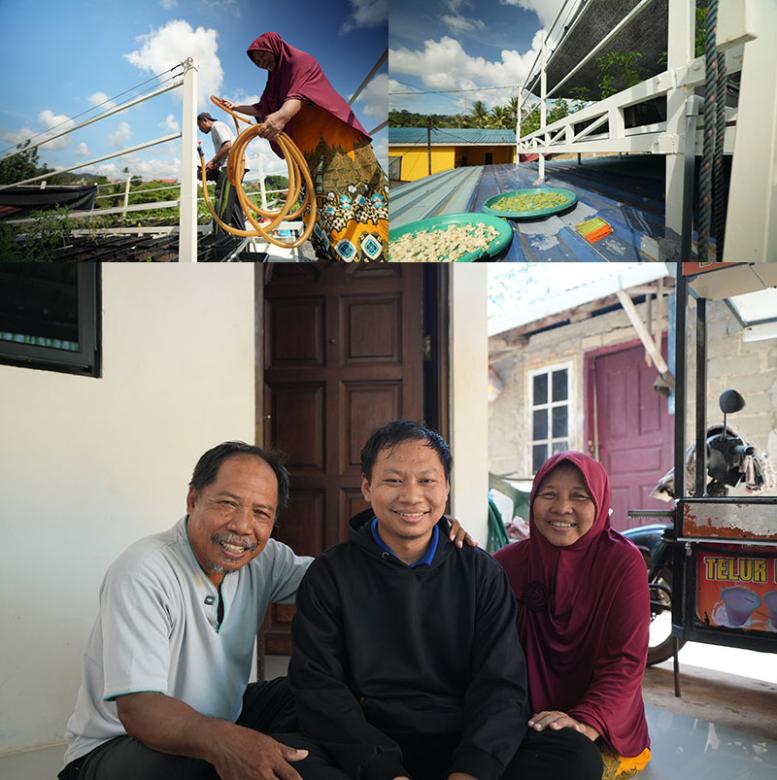
(Clockwise from top left) Kartina and Muhaeni tending to the vegetables in their rooftop garden that provides a two-layer insulation against external heat; and with their son Mohamad Wahid. Photos by Habitat for Humanity Indonesia/Budi Ariyanto.
Donate
Open the door to brighter futures for many families in Asia and the Pacific.
In Kampung Sukadamai (“Village of Peace” in Indonesian), Kartina and her husband Muhaeni are among the first few families who opted for a passive cooling design that is in line with their interest. “When I learned about rooftop gardening, my passion came out,” said Muhaeni, who worked as a gardener for a few years in late 1990s. Given the local community’s love for gardening, their village is informally known as Kampung Sayur, or Village of Vegetables.
Tending to the rooftop garden is now part of Kartina’s daily routine. She wakes up early to help her husband prepare egg-based snacks and iced coconut drinks for his motorcycle cart. Then the couple will climb a ladder by the wall of their home to go up to their rooftop garden. For about two hours, they will water and tend to their 140 pots of tomato, eggplant, spinach, eggplant and celery. When the vegetables are ready for harvesting, they plan to sell the additional crops after keeping some for their own consumption.
Design features
According to Santo, a construction supervisor with Habitat Indonesia, the design of the rooftop garden provides a two-layer insulation against external heat. The soil of the planters provides thermal mass which absorbs the sun’s radiant heat and dissipates it slowly, and the planters rest on a metallic structure built above a sloped zinc roof, which then eliminates the heat conducting down to the living space below. Additionally, evapotranspiration by the plants and soil produces a natural cooling action, lowering local air and surface temperatures.
Kartina and her husband Muhaeni built a new home in 2023 under a partnership between Habitat Indonesia and Habitat Singapore. Before they partnered with Habitat, they were living in a house made of wood that made one feel warm just staying indoors. Muhaeni said. “Previously, we had to use a standing fan and turn on the ceiling fan daily. Now, not every day.”
A village leader for 12 years, Muhaeni said he knows all the 450 families in Kampung Sukadamai. Two years after moving into their new home, he built a veranda with a tiled floor. That’s where he, his wife and their son Mohamad Wahid could relax, chat and have snacks.
Since 1997, Habitat for Humanity Indonesia has been working with families like Tasnih to build or improve a place they call home. Through multisector partnerships, Habitat builds resilient homes with communities, strengthens policies and inspires action for housing. Learn more at habitatindonesia.org