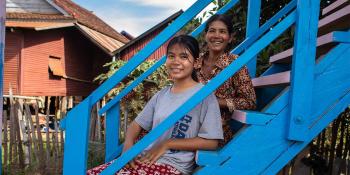
Let's open the door to gender equity
International Women's Day is more than an annual observance. For women and girls, equitable access to housing means they can live life on their own terms. Read more stories.
MANILA (March 8, 2026) — At Habitat for Humanity, we believe everyone should have the opportunity to envision their future on their own terms. It all starts with an open door. Justice. Inclusiveness. Sustainable housing for all.
This International Women’s Day, we want to highlight the daily realities of the women and girls we work with. We share some stories that show how a safe, affordable home sparks wider change.
Facebook photo from Habitat for Humanity Fiji
Build more and smarter homes. By 2050, urban areas are expected to house an estimated 70% of the world’s female population, totaling 3.3 billion. One third of these women and girls could find themselves living in inadequate housing or slums or informal settlements (UN Women, 2023). Women are less likely to own or earn resources, make decisions or access services related to housing, they are more likely to experience energy poverty and they are more likely to die or be injured in disasters.
When Melania lost her husband in 2018, she would not have thought it possible to have her own safe, secure home amid rising construction costs. With the support of Habitat for Humanity New Zealand, she partnered with Habitat for Humanity Fiji to build a new home. Now she shares a cyclone-resilient home in Fiji with her son and daughter-in-law that is designed to withstand strong winds and extreme weather. “It’s a blessing,” Melania said.
Photo ©Habitat for Humanity Nepal/Abisek Bista
Transform the housing sector to increase housing access. The housing system does not serve all people equally. Despite the progress in recent years, 740 million
women still lack access to financial services (UNDP, 2023). Gender pay gaps, limited access to credit, lack of awareness of available financial services, and exclusion from decision-making spaces constrain women’s ability to purchase or improve housing, especially in rural or indigenous communities where financial information is often shared in male-dominated forums.
Lalita gained confidence in starting her own business after being trained in financial literacy through Habitat for Humanity Nepal’s microfinance partner. With some savings, she and her husband set up a shop just outside their home, selling household items and tea. As part of the training, she also learned about ways to make her home safe. She started building a new home incrementally in 2022 and was looking forward to expanding the upper story.
Transform the housing sector to increase housing access. Through our work, we also support women to influence market, social, economic and political systems to address their concerns through advocacy and policy change. In the coastal community of Tanjung Kait, Habitat for Humanity Indonesia works with long-term residents like Komariyah (pictured above) to secure land tenure and upgrade their homes and community facilities. Habitat Indonesia also partnered with communities and local governments to leverage village funds to provide adequate housing.
Facebook photo from Habitat for Humanity Hong Kong
Inspire action for housing through deep engagement with individuals. Women are already volunteering their time and energy in Habitat’s programs across the Asia-Pacific region and around the world. We draw on their power and potential to catalyze change through advocacy and influencing. In Hong Kong SAR, China, Habitat launched its Women Build program in 2025 to address the pressing need for safe, secure housing for single mothers and their children. Emily Lam-Ho, a passionate advocate for Habitat Hong Kong, continued her support by chairing the Women Build Advisory Committee.
Facebook photo from Habitat for Humanity Fiji
Build more and smarter homes. By 2050, urban areas are expected to house an estimated 70% of the world’s female population, totaling 3.3 billion. One third of these women and girls could find themselves living in inadequate housing or slums or informal settlements (UN Women, 2023). Women are less likely to own or earn resources, make decisions or access services related to housing, they are more likely to experience energy poverty and they are more likely to die or be injured in disasters.
When Melania lost her husband in 2018, she would not have thought it possible to have her own safe, secure home amid rising construction costs. With the support of Habitat for Humanity New Zealand, she partnered with Habitat for Humanity Fiji to build a new home. Now she shares a cyclone-resilient home in Fiji with her son and daughter-in-law that is designed to withstand strong winds and extreme weather. “It’s a blessing,” Melania said.
Photo ©Habitat for Humanity Nepal/Abisek Bista
Transform the housing sector to increase housing access. The housing system does not serve all people equally. Despite the progress in recent years, 740 million
women still lack access to financial services (UNDP, 2023). Gender pay gaps, limited access to credit, lack of awareness of available financial services, and exclusion from decision-making spaces constrain women’s ability to purchase or improve housing, especially in rural or indigenous communities where financial information is often shared in male-dominated forums.
Lalita gained confidence in starting her own business after being trained in financial literacy through Habitat for Humanity Nepal’s microfinance partner. With some savings, she and her husband set up a shop just outside their home, selling household items and tea. As part of the training, she also learned about ways to make her home safe. She started building a new home incrementally in 2022 and was looking forward to expanding the upper story.
Transform the housing sector to increase housing access. Through our work, we also support women to influence market, social, economic and political systems to address their concerns through advocacy and policy change. In the coastal community of Tanjung Kait, Habitat for Humanity Indonesia works with long-term residents like Komariyah (pictured above) to secure land tenure and upgrade their homes and community facilities. Habitat Indonesia also partnered with communities and local governments to leverage village funds to provide adequate housing.
Facebook photo from Habitat for Humanity Hong Kong
Inspire action for housing through deep engagement with individuals. Women are already volunteering their time and energy in Habitat’s programs across the Asia-Pacific region and around the world. We draw on their power and potential to catalyze change through advocacy and influencing. In Hong Kong SAR, China, Habitat launched its Women Build program in 2025 to address the pressing need for safe, secure housing for single mothers and their children. Emily Lam-Ho, a passionate advocate for Habitat Hong Kong, continued her support by chairing the Women Build Advisory Committee.