Opening the door to hope
Dan Peyton, head of impact and engagement at Habitat for Humanity Australia, has spent more than a decade helping connect people to Habitat’s mission through fundraising, volunteering and partnerships. Along the way, he has seen how a safe home can change the course of a family’s life.
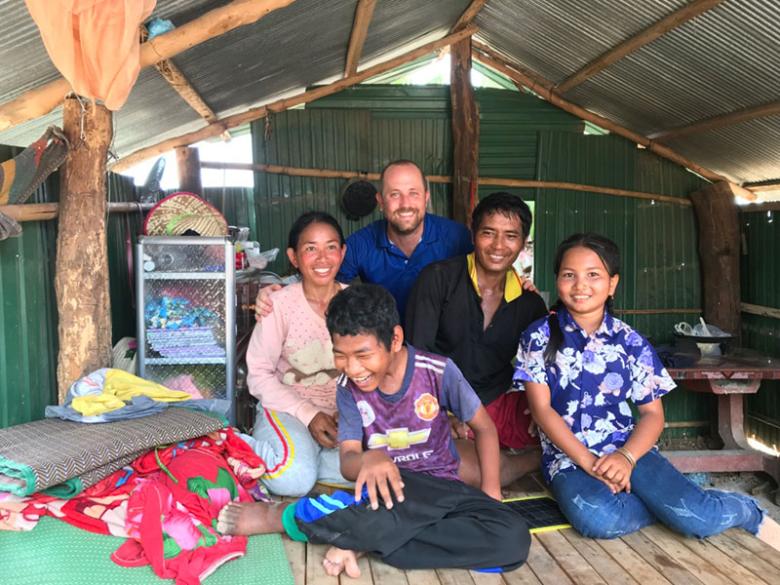
Habitat Australia’s Dan Peyton with the Cambodian family who left a deep impression. The mother has since died following a terminal illness. Photos courtesy of Dan Peyton.
The family Dan Peyton met in Cambodia had been living with more than their share of hardship. The mother was living with a terminal illness. The father caught rats for a living, earning just US$1 a kilogram. Their son had severe cerebral palsy. Their daughter cycled miles to school each day.
Toward the end of the build, the father told Dan something he hadn’t expected. Each night, he would wake up and find his wife standing outside their new home, smiling from ear to ear.
The mother has since passed away. But she died knowing her children would have a safe place to live.
Over the years, experiences like this have shaped how Dan thinks about impact, and what a home can make possible.
“When people have a safe place to live and a thriving community around them, they’re empowered to use their strengths to build better futures for themselves and others.”— Dan Peyton
What impact really means
Dan didn’t set out to work in housing. When he was approached to join Habitat for Humanity Australia’s fundraising team over a decade ago, he knew little about the organization. “I initially assumed it was about protecting rainforests and koala habitats!”
Today, he leads impact and engagement, shaping how the organization brings in support and turns it into meaningful change, from individual giving and volunteering to corporate partnerships.
“What drew me in was how tangible the outcomes were, and how universal the need for a safe, decent home is.”
At first, that meant the physical things: a house, a toilet, a water system. Over time, he came to see that the deeper impact lies in the opportunities they create.
He recalls a family in Western Sydney who moved into their Habitat home just before Christmas, after escaping domestic violence. While most people were winding down for the holidays, they were stepping into stability for the first time in years.
“It reframed my place in this work,” he says. “Instead of focusing on the scale of the housing problem, I started focusing on the fact that for one family at a time, the change is immediate, profound and life‑altering. That shift has stayed with me.”
Carrying it home
Over the years, the work has found its way into his own life. Dan has volunteered on builds, bringing along friends and family. On those trips, he would connect his children with the families they were building alongside.
“My children have gained perspective on the world and a deeper appreciation for what they have. On many builds, I’ve called home and, through FaceTime, my kids have connected with the children of the families we’re building alongside,” he says.
“Their questions have changed over the years — from ‘Can I see your toy box?’ to conversations that show they now understand that happiness, health, and love matter far more than material things.”
On his arm is a tattoo of ten small bricks. Each one represents a family or volunteer team that has been part of his journey. “Knowing I’ve supported them in some small way is something I’m very proud of.”
Looking ahead
Years in this work have redefined what home means to him.
“Home is no longer just a physical space. It’s safety, belonging, and freedom to dream. It’s where you can relax, feel secure enough to create memories, and build a future. It is the foundation for everything else: opportunity, stability, and hope.”

To Dan, people can support Habitat by volunteering, donating, or speaking up for housing.
Support, he believes, can take many forms: volunteering locally or overseas, making a small monthly donation, or speaking up for housing. Whatever the contribution, the impact can be transformational, not only for families and communities being supported, but for those who choose to get involved.
And if there is one message he hopes will endure, it is this:
“The world can feel dark at times, but my wish for the next generation is that they see the good in it and recognize that even the smallest act of support for someone less fortunate can change a life, and sometimes, change it for generations.”
Get involved
Your gift of donation can open the door to brighter futures for many families in Asia and the Pacific.
.