Women and economic empowerment (Amrapali)

Partnering with Habitat for Humanity, women are entering and thriving in male-dominated sectors.

Amrapali, India

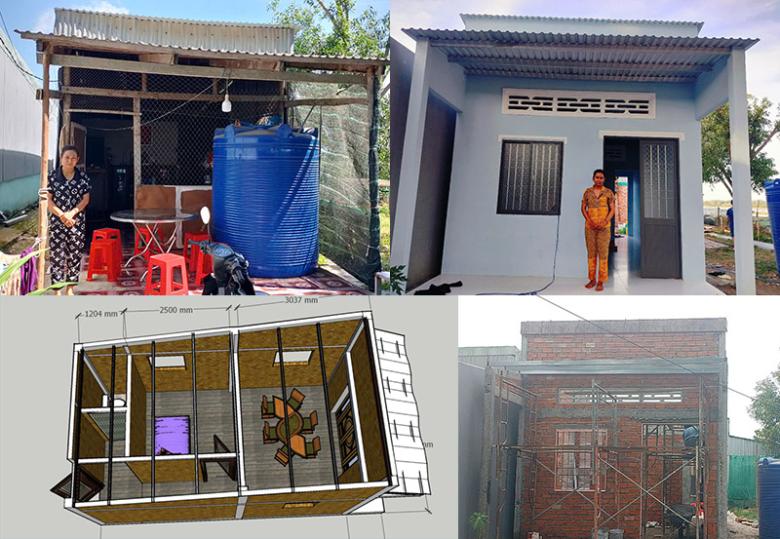
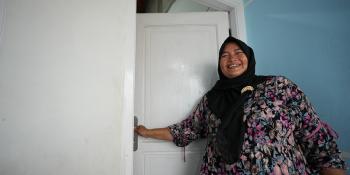
Thousands of women who took part in a multi-year initiative known as Project Nirmanshree are making headway in the male-dominated construction sector. They include Amrapali who gained certifications in entrepreneurship and related skills through government schemes with the support of Habitat for Humanity India and its partners. are making headway in the male-dominated construction sector. They include Amrapali who gained certifications in entrepreneurship and related skills through government schemes with the support of Habitat for Humanity India and its partners.

Project Nirmanshree — a combination of Hindi and Sanskrit words that means “building women” — was funded by the European Union and implemented by Habitat India. By the project’s completion in December 2023, a total of 2,710 women across four districts in India’s Odisha and Maharashtra states have improved their livelihoods and employment opportunities in housing-related trades. The initiative empowers marginalized women through construction and entrepreneurship development training, creating greater access to government services related to housing and advocacy work.

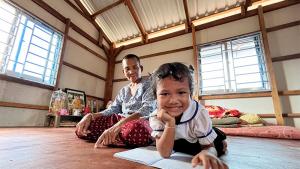
Amrapali started centering plates business after joining Habitat India's Project Nirmanshree

Video screenshot of Amrapali. She started a centering plate business after participating in the European Union-funded Project Nirmanshree in India.

Amrapali also formed a self-help group with 11 other women who each contributes 100 Indian rupees monthly into an account with a local bank. She used the seed money from the savings group to set up a small enterprise. Named after her son, Saurabh Construction Services provides centering plates that are used to support concrete slabs and beams during the construction process. The business also employs other women from Amrapali’s village. By 2023, sales revenue reached 80,000 Indian rupees with orders coming in from across the community.

“Without taking a firm decision to leave the house and start working, your family will not progress. Today, I am able to interact with bank officials and others without fear,” said Amrapali.

Women empowerment
Off
Women and economic empowerment
Amrapali started centering plates business after taking part in Habitat India's Project Nirmanshree

Story of Amrapali

Teaser image
Amrapali started a centering plate business after taking part in Habitat India's Project Nirmashree

Women’s Day, Every Day

This March, we share stories of women who partnered with Habitat for Humanity to access economic opportunities, become homeowners and volunteer to make an impact.

MANILA (March 8, 2025) — Every year, International Women’s Day is marked on March 8 in many countries. While women’s achievements are celebrated, there is no denying that challenges — and possibilities — exist. According to the World Economic Forum’s latest annual Global Gender Gap Report, it will take another 134 years to reach gender parity.

Gender equality is central to the Sustainable Development Goals. The United Nations’ landmark Pact for the Future, adopted in 2024, states that gender equality is an “essential prerequisite for sustainable development,” without which none of the goals can be achieved. Yet, a joint U.N report has found that none of the indicators and sub-indicators of Sustainable Development Goal 5, the goal for gender equality, has been met.

Corporate feminism; gimmicky; irrelevant — these are some of the criticisms leveled against marking International Women’s Day. There is, however, still meaning and value in recognizing women on March 8 every year. But we need to continue increasing awareness and action for gender equality, not only one day a year but every day until the gap has been closed.

This March, we share stories of women who worked with Habitat for Humanity to gain skills in Fiji and Tonga; access economic opportunities in Australia and India; become homeowners; and volunteer in Singapore and Hong Kong to make an impact.

Women empowerment
Off
Women's Day, Every Day
Amrapali started a centering plates business after taking part in Habitat India's Project Nirmanshree

Women’s Day, Every Day

Teaser image
Amrapali started a centering plates business after taking part in Habitat India's Project Nirmanshree

International Women's Day 2025

Women volunteers help build strong, stable communities where they live and work in Singapore and Hong Kong.
 

If we have 25 hours a day, would we use that extra hour serving others? For two women leaders, the answer would be a resounding “yes!” In fact, they would have dedicated more than that extra time to help build strong, stable communities where they live and work. Meet Soo-Lin Lee and Tammy Hoy who are making a difference through a Habitat for Humanity program to clean and declutter homes in Singapore and Hong Kong.

Soo-Lin was spurred into action by the COVID-19 pandemic. She said, “Seeing the global crisis unfold deepened my sense of purpose and urgency to make a difference.” She started with volunteering once a month before increasing the frequency to two or more monthly. Having completed 53 Project HomeWorks sessions by end-December 2024, Soo-Lin was recognized as a volunteer champion by Habitat for Humanity Singapore.

Doing something that’s of value

For Tammy, her involvement with Habitat for Humanity Hong Kong is two-fold. Currently the client experience director at JLL, she started spearheading its corporate social responsibility initiatives when she was the marketing lead. She decided on partnering with Habitat Hong Kong because of the housing nonprofit’s vision—everyone deserves a decent place to live. “We just want to make sure that whatever we’re doing is going to be something that’s of value.” She followed through with individual volunteer stints in Hong Kong as well as overseas.

Tammy Hoy (front row 4th from right) with other JLL volunteers at Hong Kong's Project Homeworks

Tammy Hoy (front row, fourth from right) with other JLL volunteers at Habitat
Hong Kong’s Project Homeworks. Photos courtesy of Tammy Hoy.

Referring to Project Home Works (spelled as two words in Hong Kong), Tammy said, “It’s really interesting. I think until people go, they don’t actually realize what the need is.” Be it interior painting or deep-cleaning, the volunteers improve people’s living conditions that are appreciated by those they helped. “There was one lady who was like ‘oh, you need to do the bathroom and the kitchen as well!” Together with her colleagues, Tammy also painted murals in schools which was fun because of the interaction with the students.

In 2018, Tammy had a different taste of volunteerism in the town of Bago in Myanmar. “We were actually building houses, which is a very different experience from what you’re doing in Hong Kong.” Joining her team were Japanese youth volunteers and Boy Scouts who contributed under Habitat for Humanity’s Young Leaders Build campaign. Tammy was impressed by the young volunteers. “We had the Boy Scouts of Myanmar join us, and they were fantastic! They were young teenagers, but they were just so responsible.

Tammy Hoy (R) and another Hong Kong volunteer in Myanmar

Tammy Hoy (R) and another Hong Kong volunteer in Myanmar.

Be it housing or other causes, both women volunteers want to give back to their community. Having a roof over one’s head, safe from the elements, is important. Tammy shares, “It means you’ve got something that is your space, where you can feel safe and know that you can go out and do what you need to do to make things work.”

She also sees value in making soup for older adults, handing out daily essentials to people experiencing homelessness. “Every single bit of that counts in terms of giving back to the community.”

Not just participate but shape spaces

Reflecting on the theme of the 2025 International Women’s Day, Soo-Lin said, “To truly accelerate action, we need more visibility for diverse role models, more education for allies, and more intentional efforts to open doors. Mentorship, sponsorship, and leadership development programs are key to ensuring women don’t just participate but also shape the spaces they’re in.” Soo-Lin is managing director and chapter lead of Singapore-based Sponsors in Tech that aims to support and empower women in technology.

Meanwhile, Tammy calls for more support for women who juggle a full-time job and a primary carer role for their children or their parents. These women need access to childcare or tutoring services or seniors’ care support. Girls and women can be empowered through training in financial literacy, women’s rights, education, job opportunities, health and wellness. In Tammy’s words, it is super important to help women feel a bit more secure in their role, be it as a mother, daughter, sister, or whatever they need to be.

Soo-Lin Lee (L) with Singapore volunteers at Project HomeWorks

Soo-Lin Lee (left) with Singapore volunteers and homeowners at Project
HomeWorks. Photos including main image courtesy of Soo-Lin Lee.

Soo-Lin shares the sentiment. “At Habitat for Humanity, giving women a safe and stable home is a fundamental step toward empowerment. But beyond shelter, we must also build networks of support where women are seen, heard, and uplifted. When we make space for women’s success in all its forms, we create stronger communities for everyone.”

Tammy and Soo-Lin are not the only ones taking action to advance the rights of women’s and girls’ rights, promote gender equality and foster empowerment. So can you — and you don’t need a 25-hour day to do so.

Happy International Women’s Day!

Gender equality
Off
International Women's Day 2025
Soo-Lin Lee-Sparrow with Singapore youth volunteers at Project HomeWorks

International Women's Day 2025

Teaser image
Soo-Lin Lee-Sparrow with Singapore youth volunteers at Project HomeWorks

Empowering youth leaders in Asia-Pacific

Habitat for Humanity will support bright young leaders to create innovative, youth-led housing solutions. Learn more about our  three-strand youth engagement initiative in the Asia-Pacific region.

Teaser title
Empowering youth leaders in Asia-Pacific

Habitat Youth Solutions 2025

Young people have the potential to be effective agents of change within their communities. As such, the Habitat Youth Solutions will support young people to start, replicate, or scale up their solutions to housing challenges in the Asia-Pacific region.  

Teaser title
Habitat Youth Solutions 2025

Tsunami20 — The lessons we learned

Many staff members — past and present — were involved in rebuilding homes and lives through Habitat for Humanity’s multi-year response to the 2004 Indian Ocean tsunami. They share their reflections.

Many staff members — past and present — were involved in rebuilding homes and lives through Habitat for Humanity’s multi-year response to the 2004 Indian Ocean tsunami. They share their reflections.

1 / 3

“Habitat Indonesia and the tsunami response gave me a better understanding of what Habitat is; changing lives and giving hope to people who do not think there is a possibility.”
- Belaynesh Tadesse, Habitat’s director of business strategy, finance and administration, Asia-Pacific. She was finance manager for Habitat Indonesia’s tsunami response.

“Despite the time needed to build capacity, women’s involvement ensures good construction quality and focuses on timely completion. Moreover, if women are directly involved in construction, they can earn income, eradicating vulnerability in the affected areas.”
- Arwin Soelaksono, Habitat Indonesia’s program director. He was involved with its early recovery phase and housing recovery program in Aceh.

“Preparing communities, setting up infrastructure, and ensuring materials were available required tireless effort, but the reward of seeing volunteers connect with affected families made it all worthwhile.”
- Patrick Ettampola
Habitat’s senior development officer, individual giving. In 2005, he was deployed to southern India to conduct tsunami damage and needs assessments. Later he transitioned to hosting international volunteers.

“Habitat’s response evolved from building full houses after disasters to home repairs; distribution of shelter kits; damage assessments; training, etc.”
- Mario Flores, Habitat’s director for disaster risk reduction and response, field operations. He had worked with staff in four countries to implement Habitat’s tsunami response.

“Looking back, a people-centered approach could have resolved some of the challenges that Habitat faced in the Thailand tsunami response.”
Ernesto Castro-Garcia, Habitat for Humanity’s vice president of Latin America and the Caribbean. He was director of Habitat’s tsunami response project in Thailand.

Partnerships strengthened Habitat for Humanity India’s tsunami response that increased the awareness of safe, resilient shelter. Training in masonry skills and production of construction materials expanded livelihood opportunities.
- Samuel Peter, former director of disaster response, Habitat India

On the tsunami’s 20th anniversary, Habitat India’s Annacharly Jeyaraj is grateful for volunteers who partnered with communities to build resilience. He is director of international volunteer programs and individual fundraising.


“Habitat Indonesia and the tsunami response gave me a better understanding of what Habitat is; changing lives and giving hope to people who do not think there is a possibility.”
- Belaynesh Tadesse, Habitat’s director of business strategy, finance and administration, Asia-Pacific. She was finance manager for Habitat Indonesia’s tsunami response.

“Despite the time needed to build capacity, women’s involvement ensures good construction quality and focuses on timely completion. Moreover, if women are directly involved in construction, they can earn income, eradicating vulnerability in the affected areas.”
- Arwin Soelaksono, Habitat Indonesia’s program director. He was involved with its early recovery phase and housing recovery program in Aceh.

“Preparing communities, setting up infrastructure, and ensuring materials were available required tireless effort, but the reward of seeing volunteers connect with affected families made it all worthwhile.”
- Patrick Ettampola
Habitat’s senior development officer, individual giving. In 2005, he was deployed to southern India to conduct tsunami damage and needs assessments. Later he transitioned to hosting international volunteers.

“Habitat’s response evolved from building full houses after disasters to home repairs; distribution of shelter kits; damage assessments; training, etc.”
- Mario Flores, Habitat’s director for disaster risk reduction and response, field operations. He had worked with staff in four countries to implement Habitat’s tsunami response.

“Looking back, a people-centered approach could have resolved some of the challenges that Habitat faced in the Thailand tsunami response.”
Ernesto Castro-Garcia, Habitat for Humanity’s vice president of Latin America and the Caribbean. He was director of Habitat’s tsunami response project in Thailand.

Partnerships strengthened Habitat for Humanity India’s tsunami response that increased the awareness of safe, resilient shelter. Training in masonry skills and production of construction materials expanded livelihood opportunities.
- Samuel Peter, former director of disaster response, Habitat India

On the tsunami’s 20th anniversary, Habitat India’s Annacharly Jeyaraj is grateful for volunteers who partnered with communities to build resilience. He is director of international volunteer programs and individual fundraising.


Basic
Disaster prevention and response
Off
The lessons we learned
Staff looking at houses under Indonesia tsunami response project

Tsunami20 — The lessons we learned

India
Teaser image
Habitat staff looking at houses under Indonesia tsunami response project

Tsunami20 — Generous souls

Habitat for Humanity’s response to the 2004 Indian Ocean tsunami was made possible because of the contributions of volunteers.

Habitat for Humanity’s response to the Indian Ocean tsunami was made possible because of the contributions of volunteers. They traveled thousands of miles to commit time, labor and resources. Twenty years later, families and volunteers shared memorable moments.

Sandhiya, who lives in Villupuram district in India’s southern state of Tamil Nadu, recalled how the volunteers provided support and comfort. “The quality of the construction was very good. Many international volunteers came and worked alongside us. They asked about our story while we worked together. We were very happy about such interaction that gave us mental relief at the time.”

Jean Smith and her daughter Jennifer Combs were among U.S. volunteers who helped rebuild homes in Killai village in Tamil Nadu. Jean said, “By the end of the project, we had formed wonderful friendships and mutual respect for these people who had lost everything.”

For Jennifer “my favorite part of the trip was meeting and engaging with the villagers. We played games with the kids, danced with the villagers, tried our hand at cricket, and shared meals.”

Olivia Wong, a long-term volunteer and present member of Habitat’s international board of directors, also remembered the family that her team worked with in post-tsunami Sri Lanka.

Olivia Wong helping tsunami-affected Sri Lankan family rebuild home.

Olivia Wong was among volunteers helping Sri Lankan families rebuild their homes after the December 2004 tsunami. Photo courtesy of Olivia Wong. Main photo courtesy of Jean Smith.

“My most memorable moment was the family we partnered with. It was a young family with parents and 3 kids. Their home was destroyed, and they were living in a makeshift shelter right next to their ‘new’ home. The father was earnest and worked hard to put in sweat equity to build a home for his family. He was meticulous and demanding of himself and this really made us want to work that much harder to make sure he and his family have a decent home to live in.

“The experience has shaped my view of the world and my life. On a personal level, I truly appreciate what ‘blessing’ really means. We only need to do our part to help one person to move forward one step at a time. As we combine each individual’s willingness to help, there will be a ‘tsunami’ of change.”

As Jean Smith thinks of the families who built alongside the volunteers, she said, “The project provided them with a home which enabled them to continue with their way of life. Yet, I know that they are changed forever. I hope the memories they live with have made them stronger.”

Basic
Disaster prevention and response
Off
Generous souls
Jean Smith (center) with late husband Pat Smith (second from right) were part of U.S. volunteer team

Tsunami20 — Generous souls

India
Teaser image
Jean Smith and her husband, the late Pat Smith, volunteered in India after 2004 tsunami

Tsunami20 — At home, at peace

Three families who have rebuilt their homes and lives with Habitat for Humanity India share how they have overcome challenges.

Among the worse-affected countries, India reported more than 16,000 people dead in the wake of the Dec. 26, 2004, tsunami. The country’s economic loss came to US$1.7 billion. The catastrophe highlighted the vulnerability of coastal communities. Three families who have rebuilt their homes and lives with Habitat for Humanity India share how they have overcome challenges.

Rani’s family of five used to live in a thatched house near the beach in Villupuram district, southern India. She recalled, “Suddenly, the big waves came from the sea, completely destroying our house. We didn’t know what was happening. Everyone ran from the beach to the main road to survive.” Rani’s two children were taken by her mother to a safe place. Rescued by other villagers, Rani gave birth to her third child two weeks later.

Rani (center), who survived 2004 tsunami in India, with her daughters Pavya (left) and Narmatha

Rani (center), seen with her daughters Pavya (left) and Narmatha (right), plans to build another room for her son.

With the support of Habitat for Humanity India, Rani’s family built a new brick home that was dedicated a year after the tsunami. After her husband Muniyan died in 2010, she had to bring up the children on her own. But Rani felt secure. “It is questionable whether I would have been at peace if I had not such a house.”

Currently, Rani lives with her youngest daughter Pavya while her married eldest daughter Narmatha stays in a village nearby. Rani’s son is currently working abroad in the fishing industry. She said, “I have to save some money and build another room so that my son who is going to get married will be comfortable.”

Porkalai (right), who survived 2004 tsunami, with her family members outside her home

Surya (center) has peace of mind knowing that her mother Porkalai (right) is living in a safe home. Porkalai’s grandson Vinoth (left) was visiting then.

Another villager Porkalai recalled the difficult times when many tsunami-affected families had to stay in relief camps. There was a sense of insecurity. With the support of Habitat staff and volunteers, Porkalai and her husband, who had since passed away, were able to build a new home that was more spacious, better ventilated and with access to electricity.

Porkalai’s second daughter Surya said, “Now all our children are grown up. But they come and stay with my mother and take good care of her. Even though my mother is old, we are relieved that she is in a safe house.”

Others in the village feel a sense of security. Sandhiya said, “We left our children safely at home and went to work. As a result, our family’s economic situation improved to some extent. We educated our children well and saw them get married. Now they live happily with their husbands and children.”

Her daughter Sivalaksmi recalled that there were only four or five concrete houses back then with most people living in huts. According to her, villagers respect others based on the condition of their houses. While her family had low income, they were able to build a quality home with Habitat’s support. “We got an honor that we did not have before. After that, there was an atmosphere of equality in the village.”

Sandhiya (3rd from left) with her family outside her home rebuilt after 2004 tsunami

Sandhiya (third from left) is visited by her married daughters Sivalaksmi (second from left) and Sinduja (right).

Her daughter Sivalaksmi recalled that there were only four or five concrete houses back then with most people living in huts. According to her, villagers respect others based on the condition of their houses. While her family had low income, they were able to build a quality home with Habitat’s support. “We got an honor that we did not have before. After that, there was an atmosphere of equality in the village.”

Sivalaksmi remembered being happy in their new home when she was young. It was airy and had sufficient light. Having a toilet — which they did not have before — was a new experience too.

“We felt very safe. Our Habitat home gave us hope in life.”
— Sivalaksmi
Disaster prevention and response
Off
At home, at peace
Sandhiya, who survived 2004 tsunami in India, with her daughters

Tsunami20 — At home, at peace

India
Teaser image
Sandhiya, who survived 2004 tsunami, was visited by her daughters

Tsunami20 — From survival to resilience

On the 20th anniversary of the disaster, Karnen Dasen, who lived in Indonesia’s hardest-hit Aceh province, recalled what happened.

Of the 230,000 people who were killed by the massive December 2004 tsunami, about three-quarters of them died in Indonesia alone. On the 20th anniversary of the disaster, Karnen Dasen, who lived in Indonesia’s hardest-hit Aceh province, recalled what happened.

Then a university student in Ajun village, he said, “It was a quiet Sunday morning on December 26, 2004. I had just woken up when a powerful earthquake shook my village in Aceh, Indonesia. About 30 minutes later, I heard a strange noise like a jet plane. Then I saw something I’ll never forget — a massive wall of water rushing toward us. I grabbed my sibling and ran out of the house. People were running, some hurt, others just trying to find their loved ones.

After the waves had receded, I tried to return home but debris blocked the road. As I attempted to get closer, I saw something that really shook me — many bodies were stranded among the rubble. It really hit me just how massive the destruction was.

My family members managed to escape. But about 50 people in Ajun village where I lived lost their lives. About one fifth of the houses were destroyed with many others damaged.

Surviving the tsunami and its aftermath taught me resilience and gave me the strength to face challenges. In June 2005, I began working part-time with a humanitarian organization. Since then, I’ve never wanted to do anything else.

Karnen Dasen (left) briefing Habitat volunteers on Indonesia's Batam island

As a project coordinator, Karnen Dasen (left) briefed Habitat volunteers on Indonesia’s Batam island

As a civil engineering graduate, I became passionate about disaster resilience and committed to helping communities recover and rebuild. This experience is one of the main reasons I chose to work with Habitat for Humanity. I know firsthand how important it is to have safe and resilient homes, infrastructure, and systems that protect people and help them rebuild their lives after a disaster.”

Surviving the tsunami and its aftermath taught me resilience and gave me the strength to face challenges.
— Karnen Dasen
Tsunami20
Basic
Disaster prevention and response
Off
From survival to resilience
Workers unloading construction materials from barge in Banda Aceh Indonesia

Tsunami20 — From survival to resilience

Indonesia
Teaser image
Workers unloading construction materials from a barge in Banda Aceh, Indonesia

Tsunami20 — The day our lives changed forever

Two decades after the 2004 Indian Ocean tsunami, families who were affected as well as Habitat for Humanity’s volunteers and staff share about the profound impacts.

MANILA (Dec. 26, 2024) — Twenty years have passed since the Indian Ocean tsunami struck on December 26, 2004. The deadliest and most destructive tsunami in recorded history killed over 230,000 people and left 2 million people homeless across 14 countries. According to Swiss Re, total losses exceeded US$13 billion and were mostly uninsured.  Indonesia was hit the hardest by the disaster, followed by Sri Lanka and Thailand and India in Asia and the Pacific.

Communities and individuals were also profoundly affected by one of the deadliest disasters in modern history. We share stories of individuals, families, volunteers and Habitat for Humanity staff members for whom the Indian Ocean tsunami left an indelible mark.

On
The day our lives changed forever
Destroyed home in India after 2004 Indian Ocean tsunami

Tsunami20 — The day our lives changed forever

Teaser image
People walking on the beach in southeastern India after 2004 tsunami hit
Subscribe to