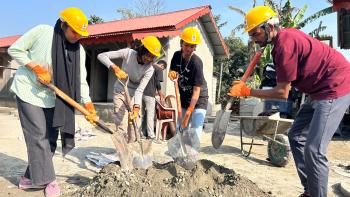
Youth 4 Humanity: Youth-led Housing and Climate Advocacy

Challenges
Youth unemployment in these areas stands at 22%, and 72% of graduates say their skills do not match available jobs. As a result, 70% of young people feel disconnected from civic life, while family pressure to migrate for remittance income often outweighs opportunities for local engagement. Those who remain in Nepal feel like they lack a platform to contribute meaningfully to their communities.
Rural youth — who make up 65% of the population — face even greater barriers, with limited access to training and professional development opportunities.
Since the 2015 earthquake, 25% of homes across Nepal remain damaged, leaving thousands exposed to ongoing risk. Each year, climate-related disasters affect an additional 80,000 people, and youth-headed households are 35% more likely to live in climate-vulnerable areas. Meanwhile, local capacity to plan and implement resilient solutions remains low.
These challenges reinforce one another: as young people leave, communities lose the next generation needed to adapt to climate impacts and rebuild safely. This creates a cycle where those most capable of driving local solutions are also the most likely to leave, slowing community recovery.


Solution
This project creates a powerful bridge between youth leadership and community needs. Our approach:
- We will establish four regional Communities of Practice for ongoing mentorship, which will work with six selected youth organizations. Bi-monthly learning exchanges share insights and build skills.
- 60 youth leaders will be trained in housing solutions and climate resilience, as well as storytelling and digital media advocacy to amplify their impact, with a goal of reaching 50,000+ young Nepalis.Trained youth organizations will be connected to national level youth networks to facilitate reach and access opportunities.
- Youth will conduct community assessments and co-create local solutions with their communities.
- Each youth organization will receive US$10,000 to implement these solutions over a period of 6 months.
- Habitat Nepal will organize four Habitat builds for youth, where volunteers will gain richer understanding of housing challenges in their community. They will also have the chance to connect with international volunteers through Global Village Program.
- Youth solutions will be showcased through a high-visibility national event.
Results and benefits
Within 12 months, youth and their communities will be empowered to drive change and contribute to several Sustainable Development Goals:
- 6 youth organizations funded and actively solving community problems (SDG 17).
- 60 youth leaders with new skills and confidence, with 50% female participation (SDG 5).
- 6 community-based housing rights projects completed (SDG 11, 13).
- Youth organizations connected to national-level youth networks.
Long-term impact
Beyond the project timeline:
- Lasting improvements in safe housing for vulnerable families, enabled through sustained youth‑led advocacy and community engagement.
- Stronger, climate‑resilient communities that are better equipped to prepare for, withstand, and recover from future environmental shocks.
- A sustainable youth advocacy network that continues to influence housing policy and champion equitable, resilient development.
- Ongoing cross‑sector collaboration among youth leaders, government institutions, and local communities, ensuring continued progress and shared ownership of solutions.
Scale-up
With additional funding, this project can be expanded to reach more youth organizations and districts across Nepal, increasing access to mentorship and technical training. Scaling up will strengthen nationwide networks for youth leaders equipped to design and implement climate-resilient housing solutions, influence local policy, and drive community-led recovery and adaptation efforts.