From Japan and New Zealand to Dobšiná: Nearly 20 volunteers will travel thousands of kilometres to support children in Slovakia
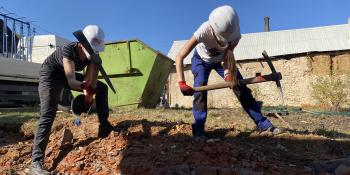
DOBŠINÁ/BRATISLAVA – October 2026 – Instead of taking a holiday, they are picking up work gloves, saws and paintbrushes – and dedicating a week to helping others. Nearly 20 volunteers from eight countries will travel to Dobšiná in early October to help renovate the premises of the Domček Parent Centre, which has been supporting children and families at risk of generational poverty for the past 13 years. The volunteers will come from as far away as Japan, New Zealand and Australia, as well as Denmark, Germany, Poland, Ireland and Croatia.
The volunteer initiative is being organised in partnership between Habitat for Humanity International and the Employee Foundation of the VKR Group. Employees of VKR Group companies support the project financially through their foundation, but this time they are also coming to help in person. They will spend a week in Slovakia, using their own hands to help create a safer and better environment for children and families in Dobšiná.
A place that means much more than a building to many children
The Domček Parent Centre has been operated by the civic association Detstvo deťom since 2013. Its work began with very young mothers, some of whom became parents while they were still of compulsory school age. Today, the centre supports children practically from birth through to school age, working both directly with families in their homes and at the centre itself.
Domček provides early childhood care, Montessori activities, preschool and school clubs, support for parents, and Babinec, a prevention programme for adolescent girls. The centre also has a library and toy-lending service, allowing families to borrow books and toys to use at home.
One of Domček’s most powerful stories can be found among the women working there today. Women who first came to the centre years ago as young mothers seeking help are now supporting other families in their own community.They visit mothers with young children in their homes and pass on the knowledge and experience they once received themselves.
“Step by step, they are also changing the life of their community through what they do in and for the community. We believe this is both an opportunity and a way to break the vicious cycle of poverty,” says Eleonóra Liptáková of the civic association Detstvo deťom.
According to data available to the association, approximately 1,520 children under the age of 18 live in Dobšiná, and an estimated 420 of them are growing up in poverty. The association emphasises that this figure is an estimate. Over its 13 years of operation, it estimates that it has directly supported more than 250 children in different ways. Most recently, it helped provide some of the school supplies needed by approximately 120 pupils and currently provides regular early childhood support to 30 children in their homes.
From New Zealand to Dobšiná – to make a difference with their own hands
The volunteers’ involvement in Dobšiná will be far more than symbolic. They will carry out practical work to improve the centre and make the spaces used by children every day safer. Their tasks will include building a new wooden fence to replace the existing unsafe fencing, constructing steps from the terrace, helping with improvements around a new gate and removing an old wall. The renovation will also include replacing windows.
Behind the week of work is a simple idea: help does not have to stop at the borders of the places we call home. These volunteers are willing to travel across Europe – and even from the other side of the world – to dedicate their time, energy and skills to a community with which they previously had no personal connection.
“VKR Group employees are proud to be part of a company that gives back to society through the Employee Foundation. Through our partnership with Habitat for Humanity, they can contribute their time, energy and skills to support families facing housing challenges. This year, they are joining forces to renovate a community centre for children in Dobšiná. We are proud to support employees who want to turn their care into concrete action and make a positive difference in the lives of others,” says Lotte Kragelund, Executive Director of the Employee Foundation of the VKR Group.
The work in Dobšiná will connect with millions of steps around the world
While one group of volunteers will be working on the ground in Dobšiná, other VKR Group employees will join them in spirit from countries around the world. From 1 to 8 October 2026, the next edition of the global Donate Your Stepschallenge will take place. Employees collect steps through walking and other physical activity, and the Employee Foundation of the VKR Group then converts those steps into financial support for Habitat for Humanity. The more steps employees collectively take, the more support they help generate for Habitat’s work.
The scale of the initiative is reflected in the results of previous years. In 2024, 697 employees from 32 countries participated, collectively recording 28.8 million steps in less than a week. Together, they covered approximately 21,938 kilometres – roughly half the distance around the Earth.
A year later, the challenge grew significantly. In 2025, 1,235 participants collectively took an extraordinary 93,814,761 steps – a distance equivalent to more than 1,600 marathons.
In 2026, this global initiative will symbolically connect with the work taking place in Dobšiná. While nearly 20 volunteers work directly in Slovakia to improve the centre for children and families, their colleagues around the world will be collecting steps that will ultimately translate into financial support for Habitat for Humanity’s work.
From work gloves in Dobšiná to millions of steps around the world, the employees are united by one idea: that their time and energy can be transformed into tangible support for others.
“These are not children who do not want to learn. They are children with enormous potential.”
Behind the repaired fence and new windows lies a much bigger challenge. Generational poverty is not simply a lack of money. It is a cycle of disadvantage that can be passed from parents to their children. From birth, a child growing up in poverty may have fewer opportunities for development – fewer stimulating activities, books or conversations, for example – and may not attend preschool. As a result, they may start school from a very different position than their peers.
Early setbacks can then trigger a chain of further challenges: poorer school performance, leaving education early, a lack of qualifications and, later in life, greater difficulty finding stable employment. If a person also becomes a parent at a very young age and without sufficient support, their own children may be born into the same circumstances. The cycle of generational poverty is repeated, and without outside support it can be extremely difficult to break.
This is why Domček does not focus solely on addressing the consequences of poverty. It begins working with children and their parents as early as possible – sometimes from the moment a child is born. The centre supports language development as well as motor and social skills, prepares children for preschool and school, and works with parents on everything from parenting skills and household management to financial literacy and family planning.
Eleonóra Liptáková rejects the idea that children growing up in poverty are not interested in education. She says that demand for the summer school the organisation runs each year is so high that Domček has to limit the number of children who can attend.
“No one will convince me that these are children who do not want to learn, who are lazy or incapable. To me, these are children with enormous potential. They are children who want to learn and who make an effort,” says Liptáková.
The results of this long-term work can already be seen among the first generation of children who have been supported by Domček. Some of the children who first joined the centre at around the age of three are now in the eighth and ninth grades. According to Liptáková, so far, none of the children who have participated in Domček’s programmes have had to repeat a school year – a significant difference compared with peers from similar backgrounds who have not had access to this support.
Habitat’s European home is also in Bratislava
Habitat for Humanity is an international nonprofit, nongovernmental organisation working to ensure that people have access to safe and decent housing. Its regional office for Europe and the Middle East has been based in Bratislava for 29 years, supporting programmes, partnerships and project financing across the region while connecting European donors with communities in need around the world.
This time, Dobšiná is reversing the usual direction of that support: for decades, Habitat’s Bratislava office has helped channel support from Slovakia to communities around the world. This October, people from around the world will come to Slovakia to help.
Media are invited to join the volunteers in Dobšiná
Journalists, photographers and TV crews are invited to visit the volunteers while they are working in Dobšiná.Media will have the opportunity to capture the renovation work and meet volunteers who have travelled from Japan, Australia, New Zealand and other countries to take part.
Available for interviews will be volunteers from the Employee Foundation/VKR Group, representatives of Habitat for Humanity, representatives of the Detstvo deťom civic association and the Domček Parent Centre, as well as people who work directly with families in the Dobšiná community.
About Habitat for Humanity International
Habitat for Humanity is a movement of people in your local area and around the world, working together to build more prosperous and vibrant communities by making sure everyone has a safe, affordable place to call home. Since our founding in 1976, together we have helped more than 62 million people globally build their futures on their own terms through access to decent housing. We’ve done that by working alongside people of all walks of life to build, repair and finance their homes, by innovating new ways of building and financing, and by advocating for policies that make constructing and accessing housing easier for everyone. Together, we build homes, communities and hope.
About Employee Foundation of VKR Group
The Employee Foundation of the VKR Group is dedicated to supporting VKR Group employees and their immediate families through grants and initiatives. Its mission spans several key areas, including crisis assistance, educational support for children, and funding nonprofit projects near VKR Group locations. Since its first partnership with Habitat for Humanity in 2022, the foundation has fostered sustainable community development through volunteer builds and the “Empty Spaces to Homes” initiative, which addresses housing shortages and promotes environmental sustainability across Europe. For more information, visit https://employeefoundation.com/en/