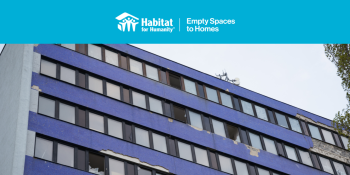
New housing research. Turning Vacant Spaces into Social Housing in Poland
Social housing and empty spaces landscape in Poland report – 2025
Poland’s housing challenge is often framed as a problem of shortage. Yet across the country, thousands of buildings stand empty or underused—many of them publicly owned—while access to affordable housing remains out of reach for low-income households and vulnerable groups. This contradiction lies at the center of a new research (August 2025) study exploring how non-residential vacancies could become part of the solution.
The 2025 study, conducted for Habitat for Humanity Poland by the Institute of Urban and Regional Development and the Institute for Structural Research, examines the scale, location, and potential of unused non-residential buildings—such as schools, factories, offices, warehouses, and service buildings—and how they could be adapted into affordable and social housing.
Rather than relying solely on new construction, the research points to adaptive reuse as a faster, greener, and more socially beneficial pathway. Repurposing existing buildings aligns with circular economy principles, reduces environmental impact, and makes use of what the study calls Poland’s “sleeping assets.”
A hidden resource at scale
Based on national datasets, the research identifies over 117,000 empty or derelict non-residential buildings across Poland—around 2.5% of the country’s total building stock. Vacancies are most common among industrial, service, and agricultural buildings, but also include schools, cinemas, and religious sites. Many of these structures are located in areas with existing infrastructure, making them technically suitable for conversion.
Urban case studies highlight how local conditions shape reuse potential. In Warsaw, around 1,600 non-residential buildings are currently unused, many already connected to heating systems and utilities. In Dąbrowa Górnicza, post-industrial sites dominate the vacancy landscape, though high remediation costs remain a challenge. Rumia, by contrast, shows short vacancy periods driven by strong housing demand and a dynamic local market.
Barriers beyond bricks and mortar
Despite this potential, the path to reuse is complex. Fragmented data systems and the lack of a unified national monitoring framework make it difficult for municipalities to identify and prioritize viable projects. Ownership structures are often complicated, while heritage protections and lengthy administrative procedures can delay or prevent conversions altogether.
The study also highlights a broader policy gap: housing, social policy, urban planning, and environmental objectives are rarely addressed in an integrated way at either national or local level.
Pathways for action
The research outlines practical mechanisms already emerging in Poland. These include Social Rental Agencies (Społeczne Agencje Najmu) acting as intermediaries to manage renovated housing stock, better integration of existing data systems for local mapping, and the use of available funding instruments such as national subsidy funds, EU renovation grants, and local revitalisation programs.
Key recommendations emphasize the importance of recognizing vacancy as a strategic resource. This includes creating a digitalized national platform to map vacant buildings, prioritizing public and social infrastructure with high adaptive potential—such as schools, offices, hospitals, and dormitories—and promoting adaptive reuse as a climate-friendly alternative to new construction. Simplifying reclassification and renovation procedures, encouraging cross-sector partnerships, and combining housing with social services are also identified as critical success factors.
Central locations play a particularly important role. Adapting vacant buildings for affordable housing in city centers can help revitalize historic areas, preserve residential functions, and counter pressures from high rents and commercial uses. Community engagement is equally essential: involving local residents in reuse processes improves acceptance and ensures that projects deliver lasting social value.
From pilot projects to systemic change
This research demonstrates that adapting non-residential buildings is both a housing and sustainability opportunity for Poland. With better policy alignment, targeted funding, and technical support, municipalities could transform neglected spaces into safe, affordable homes while advancing climate and social goals.
This study marks a new starting point.
It offers both a detailed diagnosis of non-residential vacancy and a roadmap for turning empty buildings into homes.
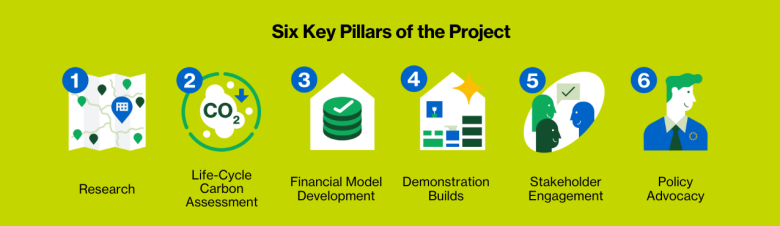
It is also part of the broader Empty Spaces to Homes initiative, built around six key pillars, with research playing a central role in mapping vacant properties and analyzing housing landscapes. This research is part of the Empty Spaces to Homes initiative, which is initiated and supported by our main partners the M&G, Laudes Foundation and Employee Foundation of VKR Group. By exploring financial and governance models that support the reuse of underutilized spaces for vulnerable groups, the initiative aims to move from isolated pilots toward a more systemic, inclusive housing model in Poland.
Read the full report to explore in detail how empty non-residential buildings can become the foundation for a fairer, more resilient housing future in Poland.