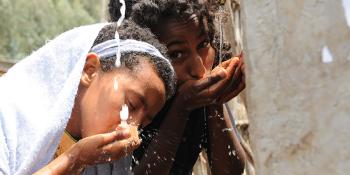
leaving no one behind
World Water Day 2019
In less than two years Ethiopia experienced two severe droughts. Despite favorable rains in 2018, the communities are highly dependent on the kiremt rains and subsequent meher harvest. Water, sanitation and hygiene in Ethiopia remain one of the main global humanitarian response priorities.
The issue of severe lack of water in certain regions of our globe is reflected in the main theme for the World Water Day 2019: Leaving no one behind. It adapts the central promise of the UN Sustainable Development Goal 6 – Clean Water and Sanitation – to ensure availability and sustainable man-agement of water for all by 2030.
Fetching Dirty Water
Damme Tesho, 25, a resident of Sinkile Guri Kebele of Jilo Gobena village of Shalla district in Ethiopia, is married and a mother of three children. Their main livelihood depends on cultivation of crops like maize, potato, haricot-bean and rearing animals.
During dry season, Damme used to collect water from nearby region in Halaba district travelling more than six hours to fetch water which was not even clean. Damme’s family used the water for drinking and cooking food and most of the time there was no water left for their personal hygiene. During rainy seasons, they collected water from ponds or road catchments near their village. For drinking, they filtered it using their dirty clothes. “It was not healthy and our children were suffering from diarrheal diseases. We were doubtful drinking the water,” says Damme.
Yet life has changed for better for Damme and almost 1000 families in Sinkile Guri, Kobo laman and Ore-Shibibo kebeles of Shalla district since they started using filter devices distributed by Habitat for Humanity Ethiopia. Families were trained on the benefits, utilization, handling and cleaning of the filter devices that, if properly used and managed, can serve them for 20 years.
“I am very happy. The filtered water is very safe. Look at this water. It is better than tap water ad even equivalent to bottled water, which is free from disease causing microbes,“ says Damme.
Fighting Water Crisis
Habitat for Humanity has been building Water Sanitation and Hygiene projects in the Arsi Negelle and Shalla districts since January 2017. Its main focus are the communities affected by the severe droughts.
Habitat is currently constructing:
- 100m3 water reservoir
- 16 public water points
- 40km pipeline installation.
The water projects will create access to safe drinking water for more than 14,700 beneficiaries.
Today, billions of people globally are still living without safe water – their households, schools, workplaces, farms and factories struggling to survive and thrive.
“I am very happy. The filtered water is very safe. Look at this water. It is better than tap water and even equivalent to bottled water, which is free from disease causing microbes.”— Damme Tesho
Fighting Water Crisis
Habitat for Humanity has been implementing water and sanitation projects in the Arsi Negelle and Shalla districts since January 2017. They focus mainly on the communities that suffer from sever droughts. Habitat is currently constructing:
- 100 cubic meters water reservoir;
- 16 public water points;
- 40 kilometers pipeline installation.
These water solutions will create access to safe drinking water for more than 14,700 beneficiaries.