ECOSTP secures $250,000 investment from Habitat for Humanity’s shelter venture fund
The startup aims to bring its self-sustainable sewage treatment technology to families in low-income areas across India.
The startup aims to bring its self-sustainable sewage treatment technology to families in low-income areas across India.
View our policy solutions to help remedy years of discriminatory housing policies and join us in helping to ensure all families have a stable, affordable place to call home.

Housing inequality is a primary culprit behind the large racial wealth gap between Black and white households in the U.S.
Mobilizing public and political will to craft and implement remedies necessary for a more just future is critical to rectifying the years of unjust housing policies that continue to impact families today.
Habitat’s Cost of Home campaign provided a vehicle for advocating for equitable housing and land use policies at the local, state and federal levels. The following is a non-exhaustive list of housing policy solutions that we can all help push forward to redress the nation’s legacy of discrimination against people of color — and especially Black Americans — and to help our nation begin to heal.
To start, we must set a goal of closing the Black homeownership gap within a generation. We can achieve that in several ways, including:
Many formerly redlined and segregated neighborhoods continue to suffer from disinvestment and economic distress. Reinvestment and tax incentives targeting these communities would help spark recovery and opportunities. But these investments must be carefully designed to ensure they don’t price out existing residents and businesses.
One promising idea is tax credits to rehabilitate distressed homes in communities with low home values, to expand affordable homeownership opportunities for residents, such as the Neighborhood Homes Improvement Act. Property tax relief for low-income homeowners and investments in home repairs are also important for ensuring existing residents can remain and benefit as their neighborhoods improve.
Segregation is the legacy of deliberate policy and zoning choices that led to the underinvestment and isolation of communities where Black households lived, and the creation of separate, higher-opportunity communities that excluded people of color. Today’s economically exclusionary zoning perpetuates this segregation. Governments at all levels are obligated to increase opportunities for Black households to live in neighborhoods with good schools and safe streets. They can do this by:
Public investment in rental affordability is critical to address the disproportionately high cost burdens and housing instability experienced by Black households. Housing choice vouchers are one of the most efficient tools for increasing affordability for very low-income renters, but currently there are only enough to assist 1 of every 4 eligible households. The federal government can quickly alleviate housing cost burdens for hundreds of thousands of Black renters by expanding voucher availability. Charlottesville, Virginia, and other cities have successfully implemented their own housing voucher programs.
A crucial, immediate step for remedying racial housing disparities is preventing eviction and foreclosure during and after the pandemic. On average, Black renters and homeowners are at higher risk of losing their homes, having entered the health and economic crisis with less access to stable and affordable homes.
Eviction and foreclosure moratoria as well as forbearance options are critical for stabilizing households during the pandemic, and just as critical is assistance to help families make up missed payments after those periods end. Foreclosure prevention assistance targeting low-income homeowners, emergency financial assistance for renters facing eviction, and extended repayment options for renters and homeowners alike are key to their — and our — recovery.
• • •
The time for racial equality is long overdue. Join us in helping to ensure that all families have access to a stable, affordable place to call home.
Read Habitat’s full Racial Disparities and Housing Policy paper for further history on discriminatory housing policy and our specific policy recommendations for a more equitable future.

Empresas probarán y validarán sus modelos de negocios con el apoyo de mentores y expertos de la industria.
With Habitat’s RV Care-A-Vanner program, you can travel in your RV to build sites across the U.S. and Canada and work alongside families as they build a foundation for a brighter future! See what builds are available.
With Habitat’s RV Care-A-Vanner program, you can travel in your RV to build sites across the U.S. and Canada and work alongside families as they build a foundation for a brighter future! Check out a few frequently asked questions to get started.
As COVID-19 grew into a pandemic, community members of Lusaka, Zambia, like Morrix stepped up to ensure their neighborhood water kiosks continued to be a safe and sanitary resource.
Morrix knows all too well just how difficult life was before the water kiosks arrived.
The 40-year-old, his wife Lucy and their four children do not have running water in their house in the Bauleni neighborhood of the Zambian capital of Lusaka. Few families in the city’s densely populated, low-income settlements like Bauleni do — most can’t afford to connect their homes to the local water system, which is run by a private company.
Before Habitat for Humanity Zambia installed a water kiosk in his neighborhood in 2019, Morrix would wake up before daybreak to collect water from a nearby farm. Sometimes his 14-year-old son Rabson would miss school in order to help.
“This farm was half an hour away on foot,” he recalls. “This early morning journey was not safe. In addition, we had to wait in long lines for our turn to draw water.”
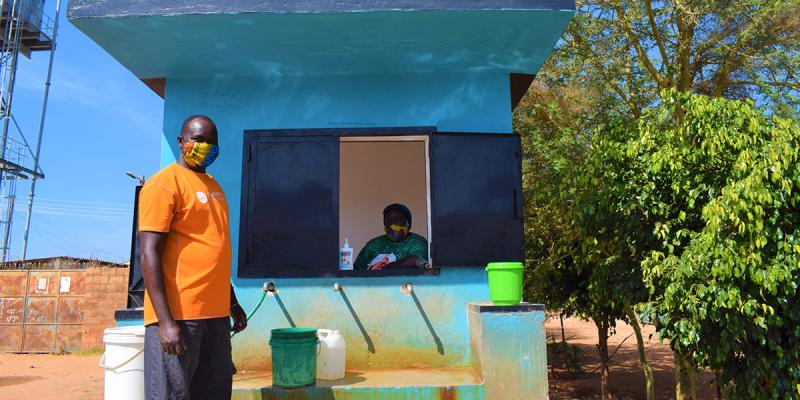
But the installation of the water kiosk around the corner from his house — a giant cement cubicle with an attendant on the inside and multiple water taps on the outside — produced a ripple effect of positive impacts.
“I spend less time on fetching water, which means that I have time to attend community meetings and spend more time with my family,” Morrix says. His family also lives healthier, with improved hygiene and sanitation. And now that Rabson does not need to miss classes, his grades have improved.
As COVID-19 grew into a pandemic, however, community residents immediately identified public water kiosks as a risk area for transmission of the disease. Large numbers of residents visit every day, collecting the water they need for drinking, cooking, cleaning and bathing.
Habitat Zambia, which has installed 28 water kiosks in and around Lusaka like the one near Morrix’s house, put out a call for help. Morrix eagerly stepped forward, taking a part-time position to help monitor his neighborhood’s water kiosk.
He ensures that people who come to use the kiosk wear protective masks and wash their hands thoroughly before drawing water. He cleans the kiosk regularly and assures that lids stay on the water containers. He does all of this to help protect his neighbors — and the water source that has made their community a healthier, better place to live.
Habitat’s Terwilliger Center for Innovation in Shelter invited startups in Southeast Asia and South America’s Andean region to meet global housing challenges.
ShelterTech brings together entrepreneurial minds to answer today’s most pressing global shelter challenges.