New housing research. Repurposing Empty Spaces to Address the Housing Crisis in Great Britain
Empty Spaces to Homes across England, Scotland and Wales – 2025
Across England, Scotland, and Wales, the housing crisis continues to deepen. Record levels of homelessness, rising temporary accommodation costs, and a chronic shortage of genuinely affordable homes are placing enormous pressure on households and local authorities alike. At the same time, thousands of buildings—many of them publicly owned—sit vacant or underused, representing a missed opportunity to respond more quickly and sustainably to housing need.
A new 2025 research report (August 2025) for Habitat for Humanity Great Britain, conducted by the Empty Homes Network, explores how these empty non-residential spaces could become part of the solution. Building on earlier research from 2021, the study examines the growing scale of vacancy across Great Britain and the untapped potential of repurposing empty buildings—particularly those owned by local authorities—into social and genuinely affordable homes.
Rather than relying on new construction alone, the research highlights reuse as one of the most immediate and socially beneficial interventions available. Many vacant commercial buildings are well located, well connected, and already part of public ownership. Bringing them back into use offers a way to address housing need while also reducing costs, supporting climate goals, and revitalising struggling places.
A growing opportunity hidden in plain sight
The research shows that commercial vacancy is rising across Great Britain. The estimated number of vacant local authority–owned buildings increased from 6,324 to 8,242 since 2021 to 2025 particularly in retail, office, and leisure sectors. With no central system to track these assets, buildings with housing potential are often sold, left vacant, or demolished—despite mounting demand for homes.
The scale of opportunity is significant. The report estimates that over 25,000 new homes could be created by converting vacant local authority–owned offices and shops alone. Beyond the public sector, data suggests that in England there are around 175,000 privately owned empty non-residential buildings, with the potential to deliver over 500,000 homes.
Vacancy pressures are felt across all three nations, though in different ways. Average vacant properties per council have increased by 30% in England, 18% in Scotland, and 44% in Wales, reflecting varied regional dynamics and shifts in how people work, shop, and use services following COVID-19.
Barriers beyond buildings
Despite this potential, progress remains uneven. The research highlights how fragmented data, limited local authority capacity, restrictive finances, and competing priorities often prevent reuse projects from moving forward. Planning systems, asset management strategies, and housing policy are frequently misaligned, leaving vacant buildings stuck between sectors and responsibilities.
Permitted development rights have opened some pathways for conversion, but these are often market-led and can result in poor-quality outcomes that fail to deliver social or community value. At the same time, councils continue to incur significant costs maintaining empty buildings, alongside the rising expense of temporary accommodation.
What works—and what’s needed next
The report points to examples of good practice across England, Scotland, and Wales, where councils, housing associations, and community-led organisations have successfully converted disused buildings into affordable or supported housing. These projects are typically enabled by strong political leadership, access to capital funding, and close coordination between housing, estates, planning, and regeneration teams.
Strategic reuse delivers benefits beyond housing supply. Repurposed buildings can revitalise high streets, reduce anti-social behaviour, support local economies, preserve built heritage, and contribute to net zero ambitions by avoiding demolition and new construction.
To scale this impact, the research calls for stronger national leadership and more joined-up approaches. This includes improved data transparency on publicly owned vacant property, embedding reuse into asset management strategies, and creating long-term funding mechanisms to support conversion and retrofit projects. Local authorities also need greater support to retain and repurpose assets, rather than being forced to sell them to address short-term budget pressures.
From disposal to stewardship
At its core, the research invites a shift in mindset. Vacant buildings should not be seen as liabilities to be disposed of, but as part of a living public infrastructure with the potential to meet housing need, support communities, and advance climate goals. As the report argues, if housing need is to be met at scale and speed, new build alone will not be enough.
This research marks a new starting point.
It provides evidence, case studies, and practical insights to support a transition from isolated projects toward a more systemic approach to reuse across Great Britain.
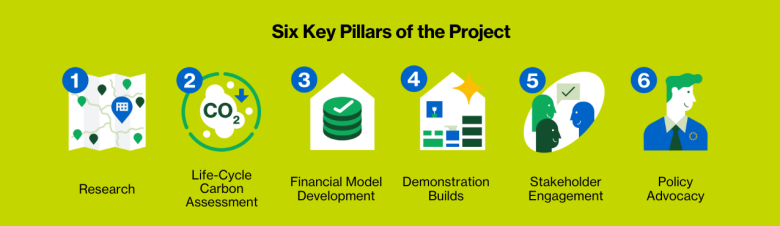
It is also part of the broader Empty Spaces to Homes initiative, built around six key pillars, with research playing a central role in mapping vacant properties and analyzing housing landscapes. This research is part of the Empty Spaces to Homes initiative, which is initiated and supported by our main partners the M&G, Laudes Foundation and Employee Foundation of VKR Group. By exploring financial and governance models that support the reuse of underutilized spaces for vulnerable groups, the initiative aims to move from isolated pilots toward a more systemic, inclusive housing model in England, Scotland and Wales.
Read the full report to explore in detail how empty non-residential buildings can become the foundation for a fairer, more resilient housing future in Great Britain.