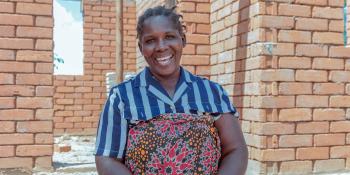
When women have a safe place to call home, communities thrive
International Women’s Day 2026
Each year on International Women’s Day, the world celebrates the achievements, resilience and leadership of women everywhere. It is also a moment to reflect on the barriers that still limit opportunities for many women and girls.
Across Africa, one of those barriers is something fundamental: access to safe and decent housing. Social norms and structural inequality often limit women’s access to education; economic opportunities; rights, including the right to housing; and asset ownership (UN Women, 2024)
A decent place to live is more than shelter. For women, it can mean the difference between uncertainty and stability, between vulnerability and dignity. Secure housing allows women to invest in livelihoods, support their children’s education, protect their health and contribute to the well-being of their communities.
This International Women’s Day, we celebrate the stories of women whose lives have been transformed through perseverance, partnership and the power of a safe place to call home.
Emebet’s 31-year journey to land ownership – Ethiopia
For more than three decades, Emebet fought to secure legal ownership of the home she shared with her late husband in Bishoftu, Ethiopia.
After her husband inherited the house from his father, the property became her only place of security. But when he passed away, Emebet faced pressure from extended family members to leave the home. Although she held documents supporting her right to remain, obtaining an official title deed proved difficult — a challenge faced by many women navigating land rights systems.
Determined to protect her home, Emebet continued to pursue her case for years. Through a long and challenging legal process, Emebet won the case, temporarily securing the house. Yet, the title deed—the ultimate proof of legal ownership—remained out of reach.
Her breakthrough came through the Stand for Her Land campaign, implemented in Ethiopia by Habitat for Humanity in partnership with the Ethiopian Women Lawyers Association. Through legal literacy training, community dialogues and advocacy sessions, Emebet gained a deeper understanding of her rights and the confidence to engage with local land administration officials.


Encouraged by the campaign, she reinitiated her appeal process. In September 2025, after 31 years of persistence, Emebet finally received the title deed to her home.
“Now I feel like a homeowner. I sleep well and can focus on building my future,” she said.
Today, she gives back to her community by partnering with Habitat Ethiopia through the campaign to train other women facing similar challenges.
For Emebet, the document represents more than legal recognition. It represents peace of mind, dignity and the freedom to focus on her livelihood and future.
Ketty builds a future through skilled work – Uganda
In Uganda, Ketty is building her future through skilled work.
Today she works as a skilled welder, producing metal products and earning a steady income that allows her to support herself and plan for the future. The journey to this moment required determination and the opportunity to learn a new trade after financial challenges forced her to leave school.
Through a collaboration between Habitat for Humanity Uganda and the Citi Foundation under the Global Innovation Challenge, Ketty received vocational training in welding — one of several construction and technical trades where young people are gaining practical, marketable skills that contribute to building and improving homes and communities.
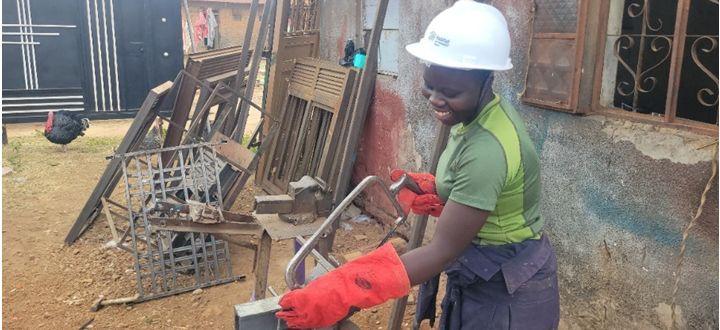
Ketty hard at work at the workshop.
Ketty is the only female trainee among 150 youth gaining hands-on experience in fields such as welding, carpentry, construction, electrical installation and plumbing. The program is helping young people transition into sustainable livelihoods while contributing to stronger, more resilient communities.
In a field where women are still underrepresented, she is proving that skilled trades are not limited by gender. For Ketty, the training has opened the door to independence and dignity.
“Now I can earn my own income and take care of my needs,” she says.
Her supervisor notes her commitment and skill in the workshop, describing her as a talented craftsperson who produces high-quality work and continues to grow in confidence.
Protecting livelihoods and coastlines – Ghana
In the coastal community of Woe in Ghana’s Anloga District, Madam Comfort is helping restore the mangrove ecosystems that protect local livelihoods and shorelines.
A vegetable farmer, fishmonger and mother of four, Comfort has witnessed firsthand the effects of climate change. Rising sea levels, coastal erosion and flooding have damaged crops and threatened incomes for families who depend on the land and sea.
Comfort volunteers in mangrove restoration through the Improved Resilience of Coastal Communities – Adaptation Fund project, a regional initiative co-implemented with UN-Habitat, ActionAid Ghana, the University of Twente, the Abidjan Convention, and national governments. The efforts are designed to strengthen natural coastal defenses and safeguard community livelihoods.


Over the past weeks, she has joined other volunteers in planting mangroves along vulnerable sections of the coastline.
Mangrove ecosystems are a lifeline for coastal communities, reducing erosion, absorbing floodwaters and protecting shorelines from storms while supporting livelihoods such as fishing.
For Comfort, resilience begins with collective action. By restoring mangroves, she and her community are helping safeguard their homes, livelihoods.
“I feel happy knowing that, in my own small way, I am contributing to a cause that will positively impact my generation and generations yet unborn,” she says.
Joyce’s dream of homeownership – Kenya
In Nanyuki, Laikipia County, Joyce and her family recently celebrated a milestone she once thought impossible: becoming homeowners.
Joyce lives with her two daughters and grandchildren and supports her family through casual jobs in the community. For years, stable housing felt out of reach.
In January 2026, volunteers from Habitat for Humanity Kenya and Habitat for Humanity Greater Rochester partnered with Joyce’s family to begin construction of a safe, decent home.
Joyce laid the first brick herself as the foundation took shape. Over the following days, volunteers and family members worked side by side mixing mortar, carrying materials and raising the walls of the new home.


“I never thought this day would come,” Joyce said. “Now I am a homeowner, and my family has a safe place to live.”
For Joyce, the house represents stability, security and a new chapter for her family.
Building foundations for opportunity
The stories of Emebet, Ketty, Comfort and Joyce show how access to housing and land can open doors to opportunity.
When women have a safe place to call home, they gain the stability needed to pursue livelihoods, support their families and contribute to their communities.
As we join the world in celebrating the strength, resilience, and leadership of women, it is imperative that safe and affordable housing is recognized and prioritized as a foundational investment in well-being and gender equality.